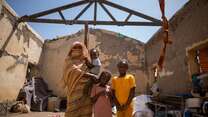
Since 1933, the IRC has provided hope and humanitarian aid to refugees and other victims of oppression and violent conflict around the world.
The IRC on Twitter
-
@LCO_orchestra @RiyadNicolas @cadoganhall Hope it's an amazing night! Thanks for your support.
May 17, 2013
-
RT @DCComics: Amazing. 2.6k of you gave $150K+ to #WeCanBeHeroes. Big thanks from DCComics @SavetheChildren @mercycorps @theIRC t.co…
May 17, 2013
-
Cyclone Mahasan update: It spared Myanmar almost entirely, and the storm’s impact in Rakhine State was minimal.
May 17, 2013
-
Cyclone Mahasan update: Storm weakened & then dissipated Thurs, causing far less damage than had been feared as it passed over Bangladesh.
May 17, 2013
-
Call Senate Judiciary Cttee & urge them to pass #CIR that includes protections for asylees & #refugees: t.co/4OQrSoAGVt #CIRmarkup
May 16, 2013
VOICES FROM THE FIELDTHE IRC BLOG
16 Days - Day 2: Cote d’What?
November 26, 2007
By The IRC
A woman enters the Basilique de Notre Dame de la Paix in Yamoussoukro for Sunday morning mass. The basilica, a replica of St. Peter’s in Rome, best exemplifies founding father Houphouet-Boigny’s aspirations for his country.
|
Comments
Ann The war isn't truely
Ann
The war isn't truely over; you're right, because the definition of end war is when all violence ceases. And it is far from that in the Ivory Coast. Keep this up, and people on the outside will learn more about this conflict.
Good luck,
dave
Hi Ann, How r u ? I hope
Hi Ann,
How r u ? I hope everythings are alright there.I'm from Ivory Coast And really like the kind of job u're doing.Take care and always give newws from u.If you want to contact me for any informations i'll be here for you.You can even call me on : [Phone number removed by IRC moderator].God be ur guide!
smile for all and distribute
smile for all and distribute flowers to women ,lets make decision togathers and build better future for our girls and boys
lets think togather women's economic contribtion in the world
lets think togather women‘s economic contribution in Africa
somthing must be done to stop women abuse all over the world
Mohammed Bush
It breaks my heart. I am glad
It breaks my heart. I am glad people are fighting for change.
Jambo Ann, Thank you for all
Jambo Ann,
Thank you for all this information Do keep it up! and take care.We are also experiencing the same in some parts Here in Kenya but we hope its going to change soon.
Ann, thank you for bringing
Ann, thank you for bringing this information to us and for all you are doing for women. Please stay safe and aware.
All right, who is the wise
All right, who is the wise person who decided to start this abuse?
Thank you very much for all
Thank you very much for all these informations.
Please, be careful!
Hi Ann keep up the good
Hi Ann
keep up the good work. You are making the unheard voices of those women getting heard. It's such an encouragement for me too to see you being brave and committed for the good cause.
Thanks Ann, for your
Thanks Ann, for your thoughtful and important work. I spent 3 years in the Cote d'Ivoire as a Peace Corps Volunteer in the Seguela region from 91-4. I feel that women have always been the glue that held the family and economy together there. The fact that the war and now post war is targeting the most integral part of their society, women, is a travesty. I thank you and your organization for your dedication to bringing us real information so the international community can get informed and act.
Take care
"I know why a caged bird
"I know why a caged bird sings, ah me,
When his wing is bruised and his bosom sore,
When he beats is bars and he would be free;
It is not a carol of joy or glee,
But a prayer that he sends from his hearts deep core"
Maya Angelou
We hear your songs, and pray for the freedom and respect of the nation's women, the only way to heal the families and men of your great continent.
Your struggle for justice for
Your struggle for justice for women and gender rights for women in the Ivory Coast is a valiant and very important one. The odds are stacked against you, but the IRC and other groups are powerful allies and resources to affect needed change.
Thank you for enlightening and updating me to the real situation on the ground for women in the Ivory Coast and surrounding areas.
Peace, Tom Sanger
Women and children all over
Women and children all over the world should not be abused and in living in extreme danger.They are suppose to be protected and cared for at all times.Something must be done to stop the abuse and danger women and children face everyday.Enough is enough.
Hi Ann, Congradulations on
Hi Ann,
Congradulations on Day 2.
Thank you for sharing this information about the struggles and social issues that these women suffer through. I really appreciate your efforts.
Please be careful Anne, while I visited Pakistan, I also shot a photo of military officers, and was at risk of losing my camera.
I look forward to reading your upcoming blogs, and I will do my best to help where I can.
Thanks again,
Saeedah (in Maryland)
keeping up with the news!
Post new comment
Voices From...
Contributors


The grass swallowing Cote d’Ivoire’s once fine highways is a sign of the country’s hard times.The narrowing roadway is hazardous, especially for women and children who travel on foot.Photo: Ann Jones After gaining independence from France in 1960, Cote d’Ivoire became Africa’s rising star—one of the most prosperous countries on the continent. Beautiful, modern Abidjan became “the Paris of Africa.” And because President Houphouet-Boigny stressed agricultural (not industrial) development, the good times spread throughout the nation of small farmers. Then came worldwide recession in the early 1980s, accompanied in Cote d’Ivoire by drought. The economy went into decline only to be kicked further downstairs by IMF-imposed “structural adjustment.” Farm prices were cut in half, teachers and civil servants laid off, natural resources snatched away—almost half the virgin rainforest in a single decade thanks to an $80 million World Bank “environmental” loan, which in turn required more “adjustment” and more loans to pay the interest. By the time “the old man” Houphouet-Boigny died in 1993, Cote d’Ivoire was in hock for about $1.5 billion. The middle class morphed into poverty.
Village women who walk to markets and health clinics complain of extortion, harassment, and rape at police and military checkpoints that still obstruct Cote d’Ivoire’s roads. Photo: Ann Jones The story since that time is all about political power plays—dodgy elections, coups and counter coups, successful and not, and ambitious politicians stirring ethnic conflicts where none existed before. Human Rights Watch reports that “politicians exploited ethnic divisions to oust political rivals in elections, using the state apparatus to repress opponents and incite hatred or fear among populations that had lived in relative harmony for decades.” The ultra-nationalist definition of pure “Ivoirite” became the wheel upon which immigrants and minorities were broken. Then there’s the widening breach between the Christian south, the seat of government, and the neglected, impoverished Muslim north.
Women with produce to transport to market complain that checkpoint soldiers interfere with their right to make a living. Extortion cuts their earnings. Fear of rape blocks their access to more profitable urban markets. Photo: Kasso Roseline In September 2002, northern rebels tried, and failed, to overthrow President Laurent Gbagbo, and the country fell into war. French, African, and later U.N. peacekeepers stepped in, and a peace treaty of sorts was signed in 2003. More than 11,000 international peacekeepers monitored a buffer zone—the Zone of Confidence—running the width of the country east to west and separating the opposing forces. But the country had already been torn apart by violence such as peaceable, tolerant Cote d’Ivoirians had never known. Now, in the midst of continuing tension and rising poverty and a series of peace treaties—issued annually—it is still trying to put itself back together. It exists, as so many countries do these days, as a “post conflict” zone. It is neither at war, nor at peace.
Soldiers supposed to protect civilians can be very threatening, like these who tried to seize my camera after I snapped this shot from an IRC vehicle. Photo: Ann Jones The fifth anniversary of the beginning of the conflict—September 19—passed without apparent incident. A day like any other. Here in Yamoussoukro, the administrative capital, it was hot, humid, overcast from time to time with clouds that gathered at dusk and rain that drenched citizens coming late from the markets. President Gbagbo was in New York, preparing to announce on September 25 on the floor of the UN General Assembly that the war is now well and truly over. But when is war “over”? The IRC, having worked in Cote d’Ivoire from 1994 to 1996, returned in 2003 to respond to the humanitarian crisis caused by the influx of Liberian refugees fleeing civil war next door. It remained to work on the fallout of Cote d’Ivoire’s home-grown conflict. There is plenty of work to do, and much of it concerns women who have been the principal casualties of the violence. I’ll tell you more next time about what IRC is doing for them.