News, Photos & Videos › Blog › The clean-up brigade
Since 1933, the IRC has provided hope and humanitarian aid to refugees and other victims of oppression and violent conflict around the world.
Recent Posts
The IRC on Twitter
-
@IRCPress You've been quoted in my #Storify story "Crisis in Darfur, 10 Years On" t.co/guLOti8F02
May 21, 2013
-
RT @IRCPress: Race against time to aid new #Darfur #refugees in Chad before rains begin: t.co/z6eDBFeR1I
May 21, 2013
-
RT @MoveEndViolence: Why do we need a #movement to end #VAWG? #MovementMaker Heidi Lehmann of @theIRC on the blog. t.co/H74c80BdAs
May 20, 2013
-
@Doylech @oneworldadopt @Just_Naomi_chan @socialfund @AFRIpads @tamaraduker @lynndalsing @HuTerra @scribblymouse thanks for your support!
May 20, 2013
-
RT @IRCuk: Thanks @LCO_orchestra @RiyadNicolas @cadoganhall for an excellent concert & for supporting our work w. Syrian refugees #TheAsfar…
May 20, 2013
VOICES FROM THE FIELDTHE IRC BLOG
The clean-up brigade
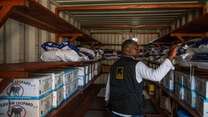
Teams of volunteers clean up litter in the Kakuma refugee camp in northwestern Kenya.
Photo: IRC
As Earth Day approaches we’re taking a look at some of the environmental concerns that arise in humanitarian crises; among them, how to address a growing litter problem in the massive Kakuma refugee camp in northwestern Kenya.
TURKANA, Kenya—They’re officially named “block health committees,” but to me, they’re the Kakuma refugee camp clean-up brigade, teams of six volunteers per block—a neighborhood of approximately 900 houses—on a mission to ensure safe and sanitary conditions within the camp.
“We work with the community health promoters,” explains Louis, one of the block leaders, referring to International Rescue Committee refugee staff members who provide health care services at the local level. “They give health messages [on topics including the importance of handwashing] to each household, while we do a hygiene inspection.”
Louis, a refugee from Sudan, checks on a family’s latrine to determine if it is clean and functioning properly, and looks around for potential mosquito breeding areas. On average, each block health committee member will visit 10 households a day in order to inspect one entire block each week.
“It is important for the Block Health Committees to be community-led,” explains Haron Emukule, the International Rescue Committee’s environmental health manager in Kakuma. Through these volunteers, all refugees like Louis, the IRC’s environmental health program is able to reach every household in Kakuma, promoting hygienic practices and encouraging families to dispose of their trash in regulated refuse pits.
In the future, notes Haron, the block health committees may become and independent entity like the community-based Hope for the Vulnerables that was born out of a previous IRC-run education and sanitation program.
Get Involved
No comments yet.
Voices From...
Contributors


Comments
Post new comment