Since 1933, the IRC has provided hope and humanitarian aid to refugees and other victims of oppression and violent conflict around the world.
Recent Posts
The IRC on Twitter
VOICES FROM THE FIELDTHE IRC BLOG
The Girl Who Wouldn’t Take No for an Answer
August 28, 2007
By The IRC
Photo: The IRC |
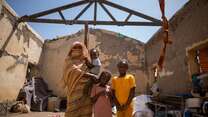
| As peace settles in Liberia, the IRC is helping refugees return home and revitalize their communities. Rebuilding Liberia’s education system is an extremely important first step on a long road to recovery. After 15 years of civil war, the future looks daunting: 70% of Liberians are illiterate. 85% are unemployed. The population is young — 55% of Liberians are under age 25 — but half of all school age children aren’t receiving an education. One of the challenges Liberian teachers face is how to help older students whose education was interrupted by the war—or who never had a chance to go to school at all—gain the skills they need to support themselves. Teacher Fertiku Harris, who’s now an IRC education manager in northwestern Liberia, shares this recollection of a teenager named Hajah whose drive to learn was so strong she wasn’t afraid to start at the very beginning—in preschool: Due to the civil war in Liberia, Hajah, a teenaged girl, fled with her family to Guinea in 1990. Despite being much older and uneducated, Hajah overcame many obstacles and received an education through the IRC. Previously Hajah never had any formal education. As part of her family’s religious beliefs, only boys were allowed to go to school. In the Lola refugee camp, Hajah’s mother built a small restaurant in a hut to support the family. Hajah was her mother’s main helper. To earn more money Hajah regularly took food to sell at the Lola Refugee School. Hajah’s frequent visits to the school piqued her interest in education. She admired the teachers. She stopped by the ABC class, which was for the youngest children, to observe. After class, Hajah would ask the children to teach her the alphabet. To encourage the children to teach her, Hajah offered them free food. Hajah began to spend more time studying the alphabet. This did not please her mother, who expected more money. Hajah’s mother complained that Hajah was not putting in enough time helping. One day, two of my friends and I were eating in Hajah mother’s restaurant, when Hajah brought us a small paper and asked us to drill her on the letters E to O. That was what the children gave her to practice reading and recognizing. While I started to help, her mother shouted, ‘Hajah! Come here. You don’t work anymore. Come and serve the people!’ Hajah quickly heeded her mother, and didn’t have the chance to come back for the drill. The next day Hajah left to sell food at school, and this time she entered and sat with the ABC children in class. At 15, Hajah was much taller and bigger than the other students. We offered to allow Hajah to go to school for free. One of the female teachers followed up with Hajah’s mother who argued that Hajah could not accept. The mother said she needed Hajah to help with work. Hajah insisted that she wanted to go to school, and promised her mother that she would continue to help with the work before and after school. After much persuasion, Hajah’s mother finally agreed. Hajah began school in the ABC class in 1992 at the Lola Refugee School. At first some of the students in different grade levels made fun of Hajah, but she ignored them and soon won them over. Hajah became part of the school family. Hajah took her education seriously. Her eagerness to learn and to make up for lost time allowed her to move ahead quickly. She skipped grades on two occasions and eventually graduated from high school in 2003, when she was 26. Later Hajah got the opportunity to continue her education when she was resettled in the United States by the International Organization for Migration (IOM). Hajah is a shining example of how an overlooked child can succeed with educational opportunities—the same opportunities the IRC is offering to more and more Liberians today. |
Comments
Hajah reminds me of an Afghan
Hajah reminds me of an Afghan girl, age 22, whom I have been tutoring for about 5 years. She, like Hajah, had never had the opportunity to go to school, neither had her brothers or mother and aunt. Unfortunately, she and her brothers were placed in age appropriate classes in high school and the odds of success was little to none. She is determined to get her education and has pushed through the taunts of other students for being dumb and doesn't give up in spite of a learning disability. She is well on her way to getting a high school diploma through adult school, has a job, and has passed her citizenship test. Some of our friends heard of her determination to learn, and we were able to get donations to purchase a computer program called Kurzweil 3000 that reads her text books to her while hightlghting the words. I have not asked her permission, so don't want to give out her name, but we are very proud of her.
I THINK IT'S GREAT!!!!!SHE
I THINK IT'S GREAT!!!!!SHE DID A WONDERFUL THING. I PRESENTLY HELP OUT LIBERIAN REFUGEES IN ST. LOUIS, MO. A LOT OF THEM NEED HELP IN EDUCATION. I HAVE BEEN TRYING TO GET HOOKED ON PHONICS FOR THEM BUT I CAN'T AFFORD THEM MYSELF. I AM GLAD THAT IRC IS HELPING REBUILD THE LIBERIAN EDUCATION SYSTEM. I AM ALSO GLAD THAT THE IRC IS HELPING THESE LIBERIANS TO COME TO THE US FOR FURTHER EDUCATION. BEFORE THE WAR, IN THE MID 70'S, THE LIBERIAN GOVERNMENT WOULD SEND STUDENTS TO THE US TO OBTAIN THEIR MASTERS DEGREE IN PUBLIC ADMINISTRATION. THE GOVERNMENT WOULD PAY FOR THE EDUCATION, HOUSING, AND GIVE A MONTHLY STIPEN. IT WAS A GREAT PROGRAM. I WISH THE IRC HAD A PROGRAM TO REUNITE SOME OF THE CHILDREN WHO ARE STILL IN LIBERIA WITH SOME OF THE OLDER LIBERIANS THAT I WORK WITH. MANY OF THESE OLDER LIBERIANS ARE OFTEN ILITERATE AND FIND IT EXTREMELY DIFFICULT TO FUNCTION IN THE US WITHOUT BEING EXPLOITED. HAVING THEIR CHILDREN HERE WOULD ALLOW THEM TO LIVE A BETTER LIFE.
keepupthe good work it just
keepupthe good work it just goes to show that some are desparate to learn and improve thier livesand make it better and posible to be able to help improve the lives of thier families and friends as well
What an inspiring story!
What an inspiring story! Everyone told Hajah no, she said yes. What amazing persistence and strength of character. Sometimes I need to read a story like this to remind myself to appreciate my education. Sometimes it's such hard work that I feel like I can't take it, but I am aware of what a gift it is. I could easily say to myself, "I wish I had her spirit," but the fact is, I CAN have her spirit if I want it, and I do. I wish all the best for whatever the future holds for Hajah.
I really don't understand how anyone can deprive their own daughter of an education. It's just horrible. This is the 21st century! It's just mind-boggling that this is still going on.
I am in awe of Hajah's
I am in awe of Hajah's perserverance and will to better herself in spite of parental, social, and peer pressure! I think it would be very beneficial for school children in the US to hear this story as well as others. In our community in California, our public schools are attended by many second language learners who need to work extra hard in their classes and can easily become discouraged. I also think it would be a big eye opener for all of our "average American kids" who often take for granted their privledged life circumstances and perhaps cause them to see education from a different perspective. Thanks for your story and your e-mail,
Marina Giessman, 42
nursing student
Clovis, California
Post new comment
Voices From...
Contributors