International Rescue Committee (IRC)

VOICES FROM THE FIELDTHE IRC BLOG

A health center on the edge of the Sahara

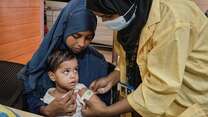
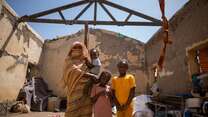
Ashta Mohamed and son Hadja enter the IRC mobile clinic in Kinimanga, in drought-stricken western Chad. 

Photos: Sophia Jones-Mwangi/IRC

The International Rescue Committee is scaling up health and nutrition programs in Chad and dispatching emergency experts to Mali as millions of people in these countries and across the drought-ravaged Sahel region face a growing humanitarian disaster. IRC media and information manager Sophia Jones-Mwangi is in Chad's western region of Bahr el Gazal, posting updates on our response there.


SALAL, Chad, April 14, 2012 —The four-hour trip from Moussoro to the Salal Health Center, on the edge of the Sahara Desert, is not for the fainthearted. Maneuvering off-road through deep sand with temperatures reaching 50 degrees Celsius (122 degrees Fahrenheit), our driver Mahamat demonstrated the expertise of a man used to negotiating this formidable terrain. I couldn’t tell the difference between the desert and the “road,” which would have taken us to Libya some 1,000 kilometers away.
 
Impressed by his skill, I asked Mahamat how he came to know the area. “I grew up here and have driven and walked this road for many years, so I know it well,” he replied. When we got stuck in the sand, it didn’t take him long to get us going again, with help from our traveling companions—Dr. Martin Bubu, the IRC field coordinator in Bahr El Gazal, and Felix Leger, the IRC’s country director in Chad—not to mention that of the lone herdsman who happened to be passing with his camels. 
Fatima Rosi with her sons Bukunu and Ali
Fatima Rosi with her sons Bukunu and Ali (sleeping). She is worried that she will lose all her cattle to the drought.
We had left the IRC base in Moussoro at 6:30 this morning and arrived at Salal Health Center just after 10 o’clock. A recent sandstorm had blocked the narrow entrance to the compound so we had to climb over the new dune. The center was buzzing with mothers and children waiting to see a doctor. It reminded me of when I used to take my children to the clinic back home in the UK for health checks.

Moms were chatting to one another, babies lying in their arms snoozing, toddlers running around amusing themselves. Most of the moms were there to collect supplementary food (a sweet paste made from corn and soya beans) from the World Food Program, which had started a weekly distribution schedule six months earlier. 

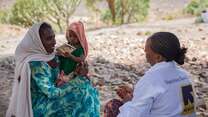
Fatima Rosi, age 25, is from Salal and was at the center to see an IRC health worker. Her sons, two-year-old Ali and three-year-old Bukunu, both had coughs. I asked her how the drought was affecting her family.

“The drought is a very big problem,” she told me. “We take care of our cattle. But now we don’t have food to feed them and there is no vet in this area to help us if any of them get sick. So when they do, they just die.” Fatima is worried about losing so many of their camels. “Three of our camels have already died in the last two months,” she said. “Now we have fifteen. I’m hoping that an organization will come and help us to take care of them, otherwise it will be a disaster.” 

One camel is worth approximately $800 and extremely valuable to a household. “In the past, we would sell a camel, and with the money from that, get food which was imported from Libya,” Fatima explained. “Now, because of the problems there, we are only surviving on the milk from our camels. No one has money, so there is no market to sell our camels either. We tried to plant some vegetables here but they have not survived.” 

Chatting among the mothers was a jovial Mibiro Hamid. She works at the center as a birth attendant. “I encourage pregnant mothers to come here to give birth,” she said. “Firstly, so they can avoid complications during or after delivery, such as bleeding. Women can die from this. When they come here to deliver they can have drugs, because it’s important for women to have medicine if it’s needed. Finally, here we are able to take care of the newborn baby. At home, it is easy for the child to get sick, but at least here they have a chance to be cared for.” 

Mibiro Hamid is a birth attendant at Salal Medical Center.
Mibiro Hamid is a birth attendant at the Salal Health Center.  She says that the arrival of the IRC has helped her community.
Mibiro, who is in her fifties, believes that her message is being heard, but the drought has complicated her work. It’s a matter of having enough food to eat, Mibiro explained. “In the past they would catch wild animals during times like this, but the government has banned hunting and this has worsened the situation. Even if we were allowed to hunt wild animals, there is no bush left for them to dwell in, because of the drought. We are only surviving on food from international organizations. It is not enough. Things are very hard for us.”

On a positive note, the arrival of IRC in the area two years ago has helped. “Health services are available,” said Mibiro. “IRC health workers have raised awareness in the community so people know where to go. In the past, mothers were waiting for their children to be really sick before they looked for help, and then often it was at the last stage and too late. They now know that health is here and it is free. They are encouraged to come, so they come.” 

We left Salal Health Center and made our way east across the desert to an IRC mobile clinic in Kinimanga, where we are providing health care services to nomadic communities. “Distance is a major problem for these communities,” noted Dr. Bubu, IRC field coordinator. “So we go to where they are.” The IRC operates four such sites within a 40-kilometer (nearly 25-mile) radius of Salel. IRC health workers have treated 400 people at the mobile clinics this month alone. 

When the IRC first arrived in Kinimanga, health workers were providing medicines from the back of a vehicle. Now they operate out of a simple hut of wood and straw. “The community decided to build this hut—it is their contribution,” said Dr. Bubu. “We thought that they would refuse our modern medicine, but that wasn’t the case, which is very good news for us and for them.” 

In Kinimanga, I met Ashta Mohmad, age 37, and her friend, Sultan Fouldon Issaka, age 50. Ashta is the second wife of the chief. She told me that she and her family also have been surviving on milk from their camels. “The situation isn’t good,” she said. I asked her if she remembered when things were better. “No, there have never been good times,” she replied, then corrected herself. “It is good having the clinic here,” she added. “The IRC is providing drugs and the malnourished children are receiving therapeutic food. Before, if our children got sick, we would use traditional medicines—that was all that was available.
Sometimes we would go to Salal, but because of the distance some of us wouldn’t go.”

As nomadic herders, Ashta and her family move from site to site, wherever there is pasture. But they have been in Kinimanga for several years, off and on, and in the last six months, since the mobile clinic has been operating, more families have stayed on as well. 

Sultan Fouldon Issaka had come to the clinic with her three-year-old son, Sheriff Yusif, who was complaining of stomach pains. She received medicine to treat worms. She told me that she makes the 10-day round trip to Moussoro twice a year to buy grain. The grain usually lasts four months. But she is unsure whether she will find any there next trip. “In the meantime, we will share what we have with one another,” she said. 

Nurse Ahmed Mohamed Senoussi told me that they have started to treat more children for malnutrition. “In two weeks we saw 18 new cases,” he said. The IRC is providing these stricken children with therapeutic food especially formulated for malnutrition. 

Felix Leger, IRC country director, told me that Chad is going through the “lean period,” and unfortunately, the situation will most likely deteriorate. “Some areas, as we have seen … families have nothing to eat. Many are relying on food aid. The peak is expected in June or July. It is crucial that donors and organizations like the IRC continue to reach all communities affected so that we reduce the catastrophic effects of this drought. I think we are on the right track, but we must continue the momentum.” 


To Help

 
Donate Now:  On the ground in some of the world's most troubled places, the IRC helps people at their moment of greatest need — providing shelter, medical care and safety. And we stay for as long as we are able to help in the rebuilding of lives and livelihoods. Make a tax-deductible gift today.


No comments yet.

Comments

Post new comment

The content of this field is kept private and will not be shown publicly.
Type the characters you see in this picture. (verify using audio)
Type the characters you see in the picture above; if you can't read them, submit the form and a new image will be generated. Not case sensitive.

ABOUT THIS BLOG        COMMENT GUIDELINES        DONATE        ARCHIVE