News, Photos & Videos › Blog › History Lesson - Ann Jones in Liberia
Since 1933, the IRC has provided hope and humanitarian aid to refugees and other victims of oppression and violent conflict around the world.
Recent Posts
The IRC on Twitter
-
RT @MoveEndViolence: Why do we need a #movement to end #VAWG? #MovementMaker Heidi Lehmann of @theIRC on the blog. t.co/H74c80BdAs
May 20, 2013
-
@Doylech @oneworldadopt @Just_Naomi_chan @socialfund @AFRIpads @tamaraduker @lynndalsing @HuTerra @scribblymouse thanks for your support!
May 20, 2013
-
RT @IRCuk: Thanks @LCO_orchestra @RiyadNicolas @cadoganhall for an excellent concert & for supporting our work w. Syrian refugees #TheAsfar…
May 20, 2013
-
Call members of Senate Judiciary Ctte & ask them to retain #CIR provisions that protect refugees & asylees t.co/xLIoPRWloc #CIRmarkup
May 20, 2013
-
#CIRmarkup: Sec. 3405 of U.S. #CIR bill is in markup right now. It contains important protections for #refugees, asylees & stateless people.
May 20, 2013
VOICES FROM THE FIELDTHE IRC BLOG
History Lesson - Ann Jones in Liberia
January 10, 2008
By The IRC
The Liberian lone star flag hangs on the wall of an office in the Voinjama hall of justice where men gather to register their complaints. Photo: Ann Jones |
The International Rescue Committee is working with writer, photographer and long-time women's advocate Ann Jones to help women in war zones — survivors of conflict, displacement and sexual and domestic violence — use photography to make their voices heard. Ann is blogging the year-long project from West Africa. If you're just joining us, you can read her first series of posts from Cote d'Ivoire at theIRC.org/16days. The story continues in Liberia, where Ann is blogging on Mondays and Thursdays into February.
Monrovia, Liberia Some call Liberia America’s stepchild. Some say bastard child is closer to the truth. It was founded by ex-slaves, torn from their homes and sold as commodities to the new world. They returned to Africa—nowhere near their original homes—bringing with them some of America’s worst features: elitism, discrimination, forced labor, religiosity, and a penchant for violence. They built small scale plantations, established a nation, and lorded it over resident tribes. Leaders of America’s only African “colony” set the model for autocratic African big men, until the “aborigines” rose up against them with greedy ambitions of their own. It makes a kind of perverse sense that a nation founded on violence should tear itself apart, but the results are terrible to see.
The first African-American settlers arrived on the west coast of Africa in 1822, shipped by the American Colonization Society. (Some ACS members sought to make amends for the slave trade by repatriating Africans; others just wanted to get rid of blacks.) The sponsors bought a 100 kilometer strip of coastal land from local tribes for $300 worth of dry goods and gunpowder. About 5,000 freed slaves followed. Nearly half of them died of disease, but in 1847, the survivors drew up a constitution, elected a president, and raised a simplified version of the American flag: the stripes with one lone star. They counted only themselves, the “civilized” Americo-Liberians, as citizens of the new Liberia.
For more than a century—until 1980—the Americo-Liberian elite ruled the land, while customary chiefs exploited their own system of forced labor. They hoarded women—many had a hundred wives or more—and put them to work. They made young men labor for years to earn a wife and sentenced “poachers” to servitude. Western historians, who often cite this system as the source of young men’s resentment and explosive violence, don’t ask how women felt about it.
The bold inscription on the Liberian Ministry of Justice in Monrovia recommends “justice” for “men.”
Some say the words “all men” include women. Others point out that if authorities had meant
to include women, they could have ended with the word “all”—thereby endorsing equal justice
and saving money on the lettering as well. Photo: Ann Jones
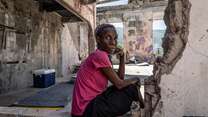
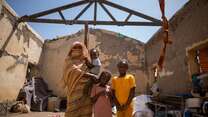
War destroys structures—schools, hospitals, and homes like these, photographed by a
Global Crescendo photographer. In Liberia, everyone lives amid the ruins of war. Photo: Hajah Kamara |
Posted in Women, Africa, Liberia | Tags: refugees, Charles Taylor, Ellen Johnson Sirleaf, humanitarian, slavery
1 comment
Comments
great blog and really
Submitted by Emmanuel (not verified) on January 10, 2008 - 5:21pm.
great blog and really informative.
Post new comment
Voices From...
Contributors


The bold inscription on the Liberian Ministry of Justice in Monrovia recommends “justice” for “men.”
Some say the words “all men” include women. Others point out that if authorities had meant
to include women, they could have ended with the word “all”—thereby endorsing equal justice
and saving money on the lettering as well. Photo: Ann Jones
War destroys structures—schools, hospitals, and homes like these, photographed by a
Global Crescendo photographer. In Liberia, everyone lives amid the ruins of war. Photo: Hajah Kamara