News, Photos & Videos › Blog › Hocus Pocus - Ann Jones in Liberia
Since 1933, the IRC has provided hope and humanitarian aid to refugees and other victims of oppression and violent conflict around the world.
The IRC on Twitter
VOICES FROM THE FIELDTHE IRC BLOG
Hocus Pocus - Ann Jones in Liberia
January 31, 2008
By The IRC
Christianity is a powerful force in Liberia, as is Islam. Photo: Anna Snyder |
The International Rescue Committee is working with women's advocate Ann Jones to help women in war zones — survivors of conflict, displacement and sexual and domestic violence — use photography to make their voices heard. Ann is blogging the year-long project from West Africa.Their story continues in Liberia, where Ann is posting updates and photos on Mondays and Thursdays into February.Talk about women’s rights in Liberia and it’s not long before some man marches out God. He’ll say, “Men are in charge of women because that’s the way God wants it.”Women answer back. Kebeh, who is not literate and has never heard of Shakespeare, says, “Women and men are the same: born in the same way in the same place. If you cut us, we bleed.”Sangai says, “If God wanted woman to be under man, he could have made her from Adam’s foot. But no, he took the man’s rib—to show we supposed to be side by side.”Annie says, “We supposed to be a helper. You want to move that table, I help you. I want to move that table, you help me. That’s how that works.”Kormassa says, “It’s not God saying we supposed to be under men. It’s culture.”Annie says, “Yeah, we used to have to walk on our knees because of culture. And we did it because we always have to look to feed our children. But now we stand up.”
Kubor says, “It was only culture that made the boy child ‘better’ in the first place.”
“What is this ‘culture’?” I ask. “Where did it come from?”
Oritha says, “Human beings made culture.”
“What if women made culture?” I ask.
Kebeh says, “Women made culture already, but men don’t respect it. They use their power to keep it down.”
Oritha says, “They use violence to keep it down. That’s what this gender-based violence is for.”
God and Allah don’t come into the equation as these women analyze life. It’s men, not gods, who keep women down. Yet standing up is not easy.
Sangai says, “We know about our rights now. But men say the GBV program will go away, and then our rights won’t do us any good because we be left without men of our own to take care of us.”
Oritha tosses her head. “I don’t care,” she says. “I’ll carry my soap to market and sell it and buy food for my children.”
These women are defiant, but they tell me of other man-made rules harder to challenge. God and Allah, it seems, are nothing compared to the power of witchcraft or the spirit world or what these women call “African signs.”
“Women are not allowed to cut in the palms,” Sangai says. She means that women and girls are forbidden to climb palm trees and cut the fruit from which valuable palm oil is made. Some women have tried, and all of them have come to a bad end. First they are said to be not women but “monkeys” who climb trees. Then, if they persist, they are killed.
“How are they killed,” I ask. “Who kills them?”
“They just die,” Sangai says. “They are killed with spirits.”
This phenomenon has been well documented in Africa: a person violates a taboo, then quickly sickens and dies for no discernable physical reason. Western observers attribute such inexplicable deaths to the power of belief.
“But why would women be killed for climbing palms?” I ask.
“Ah,” says Kebeh. “There’s money there.”
Simple as that.
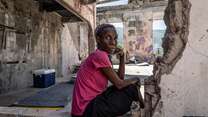
The Masonic Temple, heavily damaged during the wars, is Monrovia’s most impressive building.
The secret brotherhood still influences Liberian life, to the detriment of women. Photo: Ann Jones
The best alternative to the “Sande bush”—where girls are subjected to genital mutilation—is the public school. These girls may have a chance for a better future. Photo: Komassa Malay |
No comments yet.
Voices From...
Contributors


The Masonic Temple, heavily damaged during the wars, is Monrovia’s most impressive building.
The secret brotherhood still influences Liberian life, to the detriment of women. Photo: Ann Jones
The best alternative to the “Sande bush”—where girls are subjected to genital mutilation—is the public school. These girls may have a chance for a better future. Photo: Komassa Malay


Comments
Post new comment