News, Photos & Videos › Blog › How does a Congolese village decide what to do with $30,000? [Voices from the Archive]
Since 1933, the IRC has provided hope and humanitarian aid to refugees and other victims of oppression and violent conflict around the world.
Recent Posts
The IRC on Twitter
VOICES FROM THE FIELDTHE IRC BLOG
How does a Congolese village decide what to do with $30,000? [Voices from the Archive]
January 9, 2008
By The IRC
Photo: Lydia Gomersall/IRC-UK |
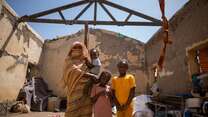
| From Lydia Gomersall, International Rescue Committee UK media and communications officer. Before joining IRC-UK in 2004, Lydia lived abroad for long periods in Japan and the United States. Her work with IRC covers over 20 conflict-affected countries worldwide. She's done a lot of work on the Democratic Republic of Congo from a distance, but her January 2007 visit there was her first experience of travel in Central Africa. The eastern Congolese district of Kaziba, home to 36,000 people in 15 villages, lies high up in the mountains, 30 bone-jarring miles by road to the southeast of Bukavu town. The scenery en route in this part of South Kivu, is breathtaking, a thin muddy track lined with banana palms, winding up vertiginous valley sides, thatched villages nestling below. The peaceful scene makes it hard to imagine the fear and anarchy that ruled here for so many decades. Reminders occasionally lurch into view - rickety trucks laden with teenage soldiers teetering precariously on piles of bedding, pots, cans, buckets and all the other paraphernalia of their peripatetic lives. Those who aren't lucky enough to find a perch atop the trucks can be seen throughout the day, trudging slowly uphill in ones and twos, each with a large gun or mortar slung casually over his shoulder. Our journey has its interruptions as a temporary log bridge is constructed over a stream that has split the road during the night and a fallen tree barring our way is sawn into removable logs. From time to time we come across a bamboo pole - one of the infamous barriers of which we had heard so much in town yesterday, where soldiers, young bullies or just unscrupulous chancers cause massive distress by extorting precious cents from those too poor to pay, just to pass along what should be a public highway. The project we are visiting is going well. It's about community ownership. Each of the participating villages had originally been allocated $700 to spend on a project of their choice. That accomplished, a much larger sum, in the region of $25,000 - $30,000, was allocated to fund a project benefiting all the villages in their community. Our staff had encouraged local officials, church and traditional leaders and other authority figures to take part right from the beginning. Once convinced, they in turn explained it within their communities. Then secret ballots were organised to elect committees to represent cross-sections of each village. In Chirimiro, a community of three villages, we stop on a grass verge outside a church, just brick walls and a tin roof with simple wooden benches lined up on an uneven dirt floor, but still the most substantial building in the mud hut village. The atmosphere inside is electric, and faces at the windows suggest that many more than the committee are interested in the outcome. Twenty-five out of a possible total of 30 committee members have brought suggestions from their villages as to how the $30,000 should be used, and a list is written up on the wall. The voting gets under way with a show of hands for each project. New maternity equipment emerges as the clear winner with 25 votes. Refurbishing the local school comes a close second, with drinking water, a tailor's shop, electricity, a grain mill, subsidised medicine and literacy and nutrition centres all getting substantial votes but not enough to be adopted. The final decision of the afternoon is that any money left over after buying the maternity equipment will be spent on the school. Although supported by the IRC, each project is the total responsibility of the beneficiaries, from planning to completion. Voting over and it is the women who are eager to talk. They want a permanent end to conflict, without which, they say, their future is bleak. They ask us to take the message home that they need our help in securing that lasting peace. Yuri, a mother of eight, has been voting enthusiastically from the rear, grandson Tresor fast asleep on her back. I ask her why she wanted to be a village representative and she smiles. 'Because,' she says, 'I want a better future for my village and the best way to do that is to get involved.' |
2 comments
Comments
That's a geat project! It's
Submitted by Lenny Karim (not verified) on June 19, 2008 - 7:54am.
That's a geat project! It's time someone noticed these forgotten villages! God bless RDC!!
I think the fact that the
Submitted by Judith McCarthy (not verified) on April 24, 2008 - 9:56am.
I think the fact that the people in the villages are being given the power to allocate the funds, through voting, is a positive step.
It is much better than just handing a village a sum of money with conditions as to how that money should be spent.
Judith McCarthy
Post new comment
Voices From...
Contributors