International Rescue Committee (IRC)

VOICES FROM THE FIELDTHE IRC BLOG

The journey to Chad

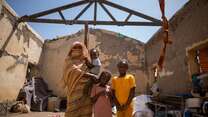
Putting the final touches to the IRC’s new compound in Hadjer Hadid. Photo: Joanne Offer/The IRC

Putting the final touches to the IRC’s new compound in Hadjer Hadid. Photo: Joanne Offer

  Joanne Offer is currently travelling in eastern Chad, near the Sudanese border, where the International Rescue Committee helps around 60,000 Darfuri refugees in two camps as well as local Chadian communities. It’s taken me eight days, four flights, two visas and a hell of a lot of paperwork to get from my base in Kenya to Hadjer Hadid in eastern Chad. The last plane of my journey is a tiny six-seater — including the pilot — and so we fly low enough to get a great view of the eastern part of this desert country. Even though it’s only a few weeks after the main rainy season, already I can see dried-up riverbeds, sun-scorched crops and arid, dusty landscapes. We fly over several russet colored hills, so I can see where Hadjer Hadid (iron mountain) got its name. I can also see two bright yellow IRC jeeps frantically clearing the runway of stray sheep in time for us to land!
With the harsh desert climate in eastern Chad, four-by-four vehicles are a must to travel safely. They’re also useful to herd stray sheep off the local airstrip! Photo: Joanne Offer/The IRC

With the harsh desert climate in eastern Chad, four-by-four vehicles are a must to travel safely. They’re also useful to herd stray sheep off the local airstrip! Photo: Joanne Offer

The IRC started to work in Bredjing camp near Hadjer Hadid in August 2008, providing essential medical care for about 31,000 Darfuri refugees and the local population. This remote area of Chad – only about 70km from the border with Darfur – is severely lacking in many of the services you or I take for granted, such as basic healthcare or reproductive services for women. In Bredjing, the IRC therefore operates a health clinic, a smaller health post and a team of community health workers who go from house-to-house in the camp raising awareness about basic health issues, such as getting children immunized or encouraging mothers to breast feed. We also use four donkey ambulances to transport sick patients – donkeys seemingly being the main form of transport for most people here, as we’ve already passed several on the way into town. Tomorrow I’ll get to see our work firsthand as I’ll be going into Bredjing itself…

No comments yet.

Comments

Post new comment

The content of this field is kept private and will not be shown publicly.
Type the characters you see in this picture. (verify using audio)
Type the characters you see in the picture above; if you can't read them, submit the form and a new image will be generated. Not case sensitive.

ABOUT THIS BLOG        COMMENT GUIDELINES        DONATE        ARCHIVE