International Rescue Committee (IRC)

VOICES FROM THE FIELDTHE IRC BLOG

Journey to Ruined Calang [Voices from the Archive]

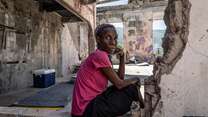
A woman scavenges through the debris where her home once stood. Indonesia was the nation hardest hit by the tsunami, with at least 168,000 people killed.

Photo: Peter Biro/The IRC.
This week marks the 5th anniversary of the devastating Indian Ocean tsunami. Days after the tsunami struck on December 26, 2004, the IRC dispatched emergency teams to Indonesia's Aceh province. At the time, the IRC's Peter Biro wrote about a journey to Calang, a village that was virtually erased from the map.
 
Our old fishing boat rolls back and forth in the rough sea. Torrential rain drums down on the window of the pilot house, even drowning out the monotonous pounding of the diesel engine. The Farabi is one of three boats that the International Rescue Committee has rented to deliver emergency specialists and badly needed food, medical, water and sanitation supplies, and hygiene items to people on the devastated coast of Aceh Province on the Indonesian island of Sumatra.
 
The Farabi is taking the emergency mobile team that I’m a part of, one of five IRC rapid response teams, to the destroyed fishing village of Calang, some 150 kilometers from Banda Aceh. With us are a group of around 20 Indonesians returning to their home villages. They were in Banda Aceh or other places farther away when the tsunami hit and are now hoping to find relatives or salvage their family’s belongings.
 
Jeni Elfiani lives in Jakarta now and has not heard from family members in Aceh since the disaster. “I don’t know what happened to them,” she tells me, clutching a small suitcase as she looks sadly at the ravaged coastline.
 
On the way, we also meet ships packed with people sailing in the opposite direction. Many survivors are heading to Banda Aceh, where there is still a concentration of international aid organizations. Days later, one departing young man told me that he and many others will abandon their homes in Aceh for good. “There are too many ghosts here,” he said.   
 
As the suns sets, a young man attempts to light a fire in the debris of the devastated fishing town of Calang. Here nearly 70 percent of the population of around 10,000 was killed. Photo: Peter Biro/The IRC.

As the suns sets, a young man attempts to light a fire in the debris of the devastated fishing town of Calang. Here nearly 70 percent of the population of around 10,000 was killed.
Photo: Peter Biro/The IRC.

We travel on and pass hills along the coastline covered in dense jungle at their peaks. The bases of the hills are stripped bare, scarred from the devastating tsunami wave and the defoliating effect of saltwater. Debris from capsized fishing boats is abundant and as darkness falls, Captain Bawang Adi slows the engine and scans the water with a searchlight.

The scheduled travel time to Calang is eleven hours. And we are only a few hours away when our trip is brought to a sudden halt. The vessel’s depth sounder has broken and rather than continuing in the dark, the captain decides to drop anchor in open seas. The boat rolls violently as we try to get a few hours of sleep.

We finally reach Calang at dawn after 22 hours at sea. The shoreline is devastated beyond imagining. Two warships from the Indonesian Navy are anchored in the bay and camouflage-clad marines are organizing the distribution of water bottles and packages of instant noodles.

Most of the survivors from this community fled into the surrounding hills, but hundreds of homeless people have erected makeshift camps near the beach to take advantage of the burgeoning aid effort. Indonesian marines are distributing old clothing, which they spread in large piles across the beach for people to pick from. It looks like a big, chaotic market.

The IRC’s Dr. Rick Brennan conducts a health assessment over the next few days and finds an urgent need for water supply and sanitation interventions. Over 80 percent of all children under the age of five are suffering from diarrhea. There are no latrines for the displaced populations and the water supply is contaminated.   

In Calang, the IRC's Tom Smith brings ashore equipment to build a system for drinking water. Photo: Peter Biro/The IRC.

In Calang, the IRC's Tom Smith brings ashore equipment to build a system for drinking water. Photo: Peter Biro/The IRC.

  In the midst of the health assessment, Brennan also learns that more than 20 percent of the households surveyed are hosting at least one orphan. Even more distressing, he found that only eight percent of the surviving population was less than five years old, a figure significantly lower than expected, suggesting that the tsunami took a very heavy toll on Calang’s children.

The majority of Calang’s displaced are now clustered by a stream on a large hill living in rickety shacks built from twisted scraps of corrugated iron and planks and other tsunami wreckage. We walk further up the hill through dense foliage to find the water’s source. The stench of feces is a clear sign that the area is being used for open defecation.

My colleague Tom Smith, an engineer, said unless latrines are built quickly, disease will spread fast. Two days later he and water and sanitation specialist Frank Broadhurst are digging them. Within a week, they will have completed 50, made from scrap lumber and plastic screens. They also hire a group of local men to collect garbage and burn debris in the area.

Water supply remains a huge problem. Smith affirms that there’s no developed water supply in the village. His team cleaned and decontaminated one well. But the plan in the next few weeks is to chlorinate surface water in a central area and to begin distributing it through a piped system.

They have their work cut out for them.

No comments yet.

Comments

Post new comment

The content of this field is kept private and will not be shown publicly.
Image CAPTCHA
Enter the characters shown in the image.

ABOUT THIS BLOG        COMMENT GUIDELINES        DONATE        ARCHIVE