International Rescue Committee (IRC)

VOICES FROM THE FIELDTHE IRC BLOG

Liberian youth get another chance at education

Photo: Emily Holland/The IRC

Photo: Emily Holland/The IRC

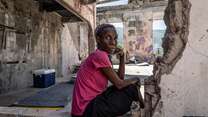
20-year-old Liberian Orlando Mesah knows the value of education.  Separated from his family during Liberia's wars and forced to flee to Guinea, he lived in a refugee camp and attended a free IRC school there.  Periodically, Orlando sent messages back home to see if any of his family was still alive.  No answer came.  Then the war ended.  Orlando was given a bucket, three sheets of roofing material and rations of oil, salt and bulgur wheat from the UNHCR and returned to Liberia.  Back home, he found his family "so poor, so hungry."  With only one year of school left, Orlando became a high-school dropout so that his family would not suffer:  "I had no money to attend school, so that is why I sat down." Now, Orlando and 99 other impoverished and vulnerable youth are getting another chance at an education.  A vocational training school nestled in the mountains in Yekepa and ravaged during Liberia's civil war is being restored to its former self.  This March, 100 students ages 13 to 25 will come to live here and learn to be electricians, mechanics and farmers.  80% of the students are female.  Many are former child soldiers caught up during the war and demobilized by the IRC.
Photo: Emily Holland/The IRC

Photo: Emily Holland/The IRC

Gabriel Davis, the IRC's child protection manager in Nimba County, was involved in the demobilization efforts.  He counseled them, cared for them.  Young men and women who left the war angry, aggressive and addicted to drugs and alcohol now rush to give him high-fives on the street and report on the progress they are making.  This vocational training school is, Gabriel explains, a way to do even more. "We are trying to reach the most vulnerable youth," he says, explaining the criteria for selection.  "Is your family able to support you?  Are you a teenage mother?  Were you abused?  Did you fight?  These are some of the questions we asked.  Then we worked with the communities, schools and social workers to make sure we were reaching the most marginalized."  I asked Gabriel if the same teachers who taught here before the war would teach again.  "If they are around," he replied.  "Many people left this place.  It was very bad here during the war." The school is a boarding school, for the most part.  Students who live in town and teenage mothers who are nursing their babies will live at home.  The day we visit, Gabriel informs me that the curriculum is being finalized, teachers trained, uniform t-shirts printed and materials gathered.  Up the hill, the dormitories are receiving a fresh coat of paint.
Photo: Emily Holland/The IRC

Photo: Emily Holland/The IRC

IRC’s work at the school is supported jointly by funds from the NoVo Foundation and Stichting Vluchteling.  Stichting Vluchteling supports enrollment costs for new students, salaries for IRC staff and tool kits to be used by students on completion of the training.  The NoVo Foundation has supported rehabilitation work at the school and residential facilities, purchased training equipment and provided business start-up funds aimed at supporting new students beyond the program. Back in New Yekepa, Orlando is counting the days until class begins.  "My dream is that I will become somebody.  IRC is helping me improve my life with education."  In the meantime, he's helping the IRC with education of another sort in his own village.  The IRC has trained Orlando and other community members to function as the eyes and ears for child abuse.  Twice a week, Orlando pays house calls to neighboring huts and homes.  He explains why child labor, child trafficking and sexual abuse (all post-war problems in Nimba County) are wrong…and why going to school is important.  Since Orlando's started doing this, there have been no reported incidents of abuse that he knows of. Child & Youth Protection and Development Director for Liberia Ibrahim Hatibu is pleased with the progress Liberian communities like New Yekepa are making.  He says collaboration is key to the effort:  “Our successes are not driven by what we present to the community but rather what the community and the IRC learn from each other.  We’re focused on making a positive, long-term impact.  The story of Orlando Mesah is just one of the many hearts that the IRC has touched.”

No comments yet.

Comments

Post new comment

The content of this field is kept private and will not be shown publicly.
Type the characters you see in this picture. (verify using audio)
Type the characters you see in the picture above; if you can't read them, submit the form and a new image will be generated. Not case sensitive.

ABOUT THIS BLOG        COMMENT GUIDELINES        DONATE        ARCHIVE