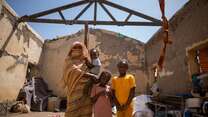
Anne Richard and an IRC colleague with a group of students whose school was damaged by the cyclone.
An update from Anne C. Richard, the International Rescue Committe's vice president for government relations and advocacy. Anne recently returned from a visit to
Myanmar, where the IRC has been assisting communities that were among the hardest hit by Cyclone Nargis. You can see her photos
here.
A helicopter flight over the Irawaddy Delta dramatically reveals the devastating path taken by Cyclone Nargis as it ripped through Myanmar’s most fertile area.
Deserted dwellings and shattered houses are scattered across the landscape, and those still inhabited are patched with plastic sheeting that covers gaping holes in roofs and walls.
“In areas like this nearly all homes were destroyed in the villages and the survivors had virtually no access to clean drinking water,” said Gordon Bacon, IRC’s emergency coordinator in Myanmar, who was leading me on a visit to some of the delta’s worst affected areas.
An estimated 130,000 people are dead or missing following the cyclone which struck in early May.
The view of the devastation at ground level proves to be equally bleak. Although it was a relief to see signs of life everywhere, it is clear that many cyclone survivors are still enduring extraordinary hardships.
But in the two remote villages we visited in the township of Ngapudaw (or Middle Island), there is also ample evidence of the solid, useful assistance being delivered by the IRC.
In Thin Gan Kone near the main dock, we pass a bright yellow IRC water pump being used by a local woman. After a boat ride of less than an hour along the busy river, we visit Ma Gyi Bin, and find more latrines, pumps and clean water systems around the village emblazoned with the IRC logo.
At the hospital, clean water is piped from a protected pond and through a water filtration system that IRC experts have installed. The clean water benefits patients, staff, visitors and neighbors.
We also visit the school. A large crack ran across the main school building; it is no longer safe. Most of the children are learning lessons in temporary huts that are open to the elements on one side.
Back in Thin Gan Kone, we are visited by a delegation of farmers from the area. The group has come to thank the IRC for distributing rice seed. The rice had been provided on time for the planting and growing season. But now the farmers have another, very serious request: could IRC give them fertilizer? Gordon makes no commitments, but promises to look into it. (Upon our return to Yangon, he is able to get a firm “yes” from the US government – one of our funders – that we can indeed use US grant monies for this purpose. At the same time, we learn the US government is not planning any further aid for the new fiscal year – even though we see many needs and consider our presence in the Delta as an important opening to reaching the poor and displaced in Myanmar).
We also meet with other IRC colleagues who are en route to visit more out-of-the way towns and villages to make sure they have basic household items that may have been lost in the Cyclone. They also want to reach more communities to give public hygiene instruction and ensure that the villagers have safe drinking water and basic healthcare.
The team also wants to build washrooms at the schools and maybe even help rebuild the school in Ma Gyi Bin (but we can’t use US government disaster assistance funding for that, and will have to raise money from private sources). They also want to do more to improve hospital facilities and ensure basic healthcare. To that end, Gordon and the team have plans to procure boats that could serve as water ambulances along the river.
As usual when I travel, I am most impressed by my colleagues – in this case, Burmese who’ve joined the IRC as well as local volunteers from the Myanmar Red Cross. They responded to the Cyclone by rolling up their sleeves and getting to work to help their fellow citizens. Grateful for IRC’s arrival in the country and eager to do more, they show me around the villages – a riot of color from the brilliant green of the rice paddies, yellow and orange blossoms on the trees, bright vegetables in the market and the crisp green and white of school uniforms. As I prepare to leave Myanmar, my new colleague Choi asks that I come back soon. Her final message still rings in my ears: “Please don’t forget us!”
You can find more about the IRC's programs in Myanmar and how you can help here.