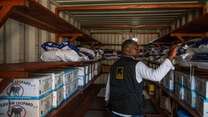
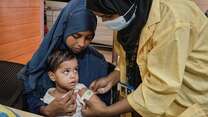
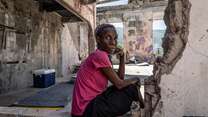
Since 1933, the IRC has provided hope and humanitarian aid to refugees and other victims of oppression and violent conflict around the world.
Recent Posts
The IRC on Twitter
-
@IRCPress You've been quoted in my #Storify story "Crisis in Darfur, 10 Years On" t.co/guLOti8F02
May 21, 2013
-
RT @IRCPress: Race against time to aid new #Darfur #refugees in Chad before rains begin: t.co/z6eDBFeR1I
May 21, 2013
-
RT @MoveEndViolence: Why do we need a #movement to end #VAWG? #MovementMaker Heidi Lehmann of @theIRC on the blog. t.co/H74c80BdAs
May 20, 2013
-
@Doylech @oneworldadopt @Just_Naomi_chan @socialfund @AFRIpads @tamaraduker @lynndalsing @HuTerra @scribblymouse thanks for your support!
May 20, 2013
-
RT @IRCuk: Thanks @LCO_orchestra @RiyadNicolas @cadoganhall for an excellent concert & for supporting our work w. Syrian refugees #TheAsfar…
May 20, 2013
VOICES FROM THE FIELDTHE IRC BLOG
Sahel drought: Huge needs in Guéra, Chad
The picturesque nature of this area belies the fact that Guéra Region is severely affected by drought.
The International Rescue Committee is scaling up health and nutrition programs in Chad and dispatching emergency experts to Mali as millions of people in these countries and across the drought-ravaged Sahel region face a growing humanitarian disaster. IRC media and information manager Sophia Jones-Mwangi recently visited the hard-hit Bahr el Gazal and Guéra regions of Chad and shared this and other other updates on the humanitarian siutauion and the IRC's response.
Mongo District, Guéra – Tuesday 17 and Wednesday 18 April – I arrived in Mongo town, an hour’s flight southwest of N’Djamena, Tuesday afternoon with Felix Leger, IRC’s country director in Chad, and Dr. Charles Ido, who will be leading our emergency nutrition response here. The first thing that struck me as the plane began its descent were the mountains and hills surrounding the town which, like its tree-lined streets, are in stark contrast to the desert plains of the Sahara. The picturesque nature of this area belies the fact that Guéra Region, which encompasses Mongo District, is severely affected by drought.
Whenever the IRC begins work in a new area, we meet with government representatives and local officials. On our first night in Mongo, Felix and Dr. Charles made a courtesy call to Ouedingue Asse-Assoué, the regional governor, who thanked the IRC for coming and stressed that malnutrition in Guéra is a major problem.
The next morning, they met with Dr. Ramat Abdoulaye Abderamen, head of Mongo Health District, who warmly welcomed the IRC. “The arrival of any partner is always a plus,” he said. “We have limited means, and it’s often thanks to the presence of partners such as yourselves that we get qualitative results.”
According to Dr. Abderamen, the drought has people looking for food and neglecting their health. “Some mothers are hesitant to go to the health centers because they don’t receive food there,” he said. “Only a few people in the community use the health centers. This is partly because there are only 17 for a population of 200,000. People prefer to go traditional healers.”
After meeting with Dr. Abderamen, we drove in the sweltering heat through a valley surrounded by giant boulders and hills. We passed women riding donkeys with babies strapped in baskets. Goats and camels munched on whatever shrubs they could find. When we arrived at Banda Health Center, it was closed. A group of women and children were waiting under a tree.
“This center should be open,” said Dr. Charles. “This is one of the major problems here. If there is only one nurse working and he or she has to go somewhere or has a meeting, the center will close for the day or part of the day.”
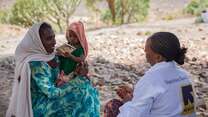
![]() |
| Zenaba and her son Photo: Sophia Jones-Mwangi/IRC) |
Banda is a farming community—beans, peanuts and millet. The last harvest was in September. Only millet can be found in the markets, but it is extremely expensive, available to but a handful of people. Even those selling it ration their portions because they don’t know when they will need it for their own use.
Both Charles and Felix believe that Mongo District presents a huge challenge. “We really don’t know how many children have malnutrition, because the children screened here in the district are only those who come to the health center,” said Felix. “I’m sure if we would screen all the villages in Mongo, we would find many more.”
The IRC plans to establish outreach teams in each of the 17 health centers in Mongo and strengthen the network of community health workers and community health committees, which at the moment is almost nonexistent. “These teams will screen all children from six months old to 59 months,” Felix explained.
The crisis in the Sahel is nothing new. Many of the people whom I’ve met these past days have been coping with drought and food shortages for many years. Felix believes that long-term solutions need to be made at by the government. “Otherwise, we are condemned to continuously act as a band-aid to the problem,” he says. “We are here to support the Ministry of Health. It is important that the state helps its population by assisting them in finding different ways of planting crops, for example. There is also a huge need to establish strong health services.
“Now we are addressing the emergency but we must help people in the long term,” Felix continued. “This is all about increasing their resilience to drought in the future. If the rains are not good in June and July, then the harvest in September will be bad. In such a case, IRC will most likely advocate to donors to continue for another year in this area beyond the nine months that we are committed to.
“If the rains are good and the harvest is good, this will give families the breathing space they need. We may think about staying and helping people to be better prepared for the next drought, which is inevitable.”
Get Involved
No comments yet.
Voices From...
Contributors


Comments
Post new comment