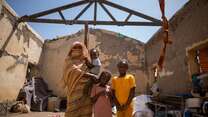
Haron Emukule, IRC environmental health manager in the Kakuma refugee camp, shows off a new "polymat" latrine. The latrine's walls are fashioned from woven material made from plastic sheets and bags salvaged from camp litter and recycled by local women’s groups.
Photo: Jane Yang/IRC
As Earth Day (April 22) approaches we’re taking a look at some of the environmental concerns that arise in humanitarian crises and how International Rescue Committee teams are working to address them.
The IRC has been working in the Kakuma refugee camp in northwestern Kenya since its inception in 1992 to shelter southern Sudanese fleeing a brutal civil war. Kakuma has become an ad hoc
town, and 20 years of camp life has had an impact on the environment. Among the emerging concerns are how to address a growing litter problem within the camp, how to properly dispose of solid waste, and how to meet the sanitation needs of disabled residents.
TURKANA, Kenya—Haron Emukule, the IRC’s environmental health manager for the massive Kakuma refugee camp, brings me to an unassuming lot named Sanitation Site 2, where staff in blue jumpers hand-mix concrete that will be poured and molded into latrine slabs.
“This was our first design,” Haron explains to me, pointing out the slabs’ circular, convex shape. Each slab requires one bag of cement and takes 21 days to cure. When ready for installation, they weigh 240 kilograms (about 530 pounds). On average, 7 percent of the slabs are discarded due to cracks that form during the production process. Even the good slabs last but three years before they must be replaced.
These issues prompted Haron and his team to begin thinking of new ways to build latrine slabs. “We wanted to find a way to improve the slab design,” he explains, “to make it lighter, stronger and less expensive per unit.”
Further down the lot, I see the result of the team’s innovative brainstorming: thin, rectangular slabs reinforced with iron mesh. Each of these slabs require only a half bag of cement and weigh 100 kilograms (about 220 pounds). While Haron and his team have only begun producing the new slabs, they expect them to last three times longer than the domed version. Even better, the new design reduces the square footage of corrugated iron needed for the walls of the latrine. It’s no wonder that more and more refugees are asking for the rectangular slabs for their family latrines.
Yet the improved slabs are not the pièce de résistance for the IRC’s environmental health team in Kakuma. Looking over a neat row of model latrines bordering Sanitation Site 2, I spot two sheathed in iron sheets next to three made of a very different material. “These are our polymat latrines,” Haron proudly tells me, opening the door to one of the pilot designs to reveal a comfortable latrine that provides privacy and better air flow.
“Polymat” is the IRC’s term for the flexible woven material made from plastic sheets and bags salvaged from camp litter and recycled by local women’s groups. Although the IRC facilitates the training of many of these women, the groups are independent organizations that produce the polymats for income.
 |
Fatuma Hamadi Emberwa is a member of one of the refugee women's group that weaves the polymats.
(Photo: Jane Yang/IRC) |
Take Fatuma Hamadi Emberwa, 38, for example. Fatuma and her family fled Somalia in 1992 and settled in Dadaab Refugee Camp in northeastern Kenya, where she learned to make polymats. In 2005, she and her family were transferred to Kakuma. Here she began to teach other refugee women the five-step process to create the unique product: collect and sort plastic, wash it, set it out to dry, twist it into tight cords and, finally, weave the strands into 1m x 1m mats. The process takes about two days.
The IRC buys polymats from women’s groups at KES 200 ($2.32) each; it takes 14 to build a latrine. That translates into a savings of KES 2000 ($23.20) per latrine compared to corrugated iron.
Standing under a large tree, Fatuma explains the procedure to me while her group weaves, making a colorful picture. She and her husband were farmers in Somalia, but now Fatuma is the sole breadwinner. “We have children who go to school and need supplies,” she says. “This project is also making the camp cleaner, which is better for our health.”
For Haron, the polymat latrines are an exciting innovation that he hopes will be introduced across the camp. Since the pilot program began in February 2011, the IRC has garnered the support of other partners in Kakuma, including the United Nations refugee agency (UNHCR).
The IRC’s environmental health team has a few more projects in the works, including the installation of specially designed latrines that are accessible to camp residents living with disabilities. They are also looking at other recycling ideas: Melting down harder plastic containers to create bases for the latrine frame poles, an ingenious way to combat termites.
I ask Haron how he feels being in charge of a program with so many dynamic components. He grins before offering his humble reply: “This is our everyday.”
 |
The polymat project provides an income for members of the camp's women's groups.
(Photo: Jane Yang/IRC) |
To Help
Donate Now: On the ground in some of the world's most troubled places, the IRC helps people at their moment of greatest need — providing shelter, medical care and safety. And we stay for as long as we are able to help in the rebuilding of lives and livelihoods.
Make a tax-deductible gift today.