International Rescue Committee (IRC)

VOICES FROM THE FIELDTHE IRC BLOG

Seeds of renewal in South Sudan

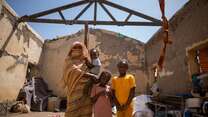
After years of war, Mary Abraham returned to her village only to find it destroyed. As a member of an IRC-organized farmers group she has been able to grow food for herself and sell vegetables in the market.

Photo: Peter Biro/IRC

As the world’s newest nation struggles to recover from decades of war, the International Rescue Committee is helping South Sudanese reestablish family and community farms.

For Mary Abraham, a resident of the South Sudanese village of Kudo, every day is a small battle for survival. When her husband, a fighter with the pro-independence Sudan People’s Liberation Army (SPLA), was killed in the civil war that rocked this East African country for over two decades, she was left to care for their three children.
 
“I didn’t have any means to farm and we were always hungry,” the 30 year old recalls. “And I couldn’t afford to send my children to school.” 
 
Mary and her family fled into the green hills surrounding Kudo, where for five years they slept under trees and in caves.
 
“We survived by eating fruit and wild vegetables,” she says.
 
After a peace accord in 2005 ended the fighting, Mary and hundreds of thousands South Sudanese returned to their villages. Most had spent long, hard years living in camps in neighboring Uganda, Kenya or Ethiopia, while others, like Mary, hid in the bush. But life in Kudo had changed.
 
“The houses were ruined and all the fields destroyed,” Mary says.
 
Despite the fact that South Sudan gained independence last July, its economy continues to stagger from decades of war and neglect. Hunger and malnutrition are widespread.
 
To help Kudo and communities like it, the IRC last year launched a program that links farmers with potential buyers and assists them in transporting their produce to markets. The IRC also provides initial grants to farmers groups to purchase tools and high-quality seedlings better able to withstand pests, disease and drought. The farmers, who choose which crops to grow and put in all the labor, also receive business training.
 
The Kudo farmers group is now growing corn, peanuts, sorghum and other vegetables.
 
“We can eat well and also sell vegetables in the market,” says Joseph Kilimanjaro, the chair of the group. “This will bring more economic activity to our village. If people have money, more goods will come in and maybe shops will open.”
 
Mary Abraham is also optimistic about the future, both her own and the country’s.
 
“For the first time, I am hopeful,” she says. “Working together like this will change our lives. And me? I can finally pay for my children to go to school.”  
1 comment

Comments

I can't even imagine a life

I can't even imagine a life like that.I am 67 yrs. old, slowly dying from COPD, and trying to live on $1026.00 a month in the US. Yet I can not fathom their kind of life. I feel very lucky to live here in the US. I am divorced and living alone, but I have a loving family and friends to lend a helping hand when I need anything. My two sons and Grand children watch over me and I feel love and care from all of them. I can only hope and pray that this community that I have just read about survives and thrives in the very near future. With people like you to help
them I feel they will. $1,026.00 isn't much here, but they would be in seventh heaven with it. I hope other people join your group and help out with cash and hard work. I know the people there will also work hard to help themselves. I hope they know that people like me that can't really contribute still care and have them in our thoughts and prayers. Thank you.
Sue

Post new comment

The content of this field is kept private and will not be shown publicly.
Type the characters you see in this picture. (verify using audio)
Type the characters you see in the picture above; if you can't read them, submit the form and a new image will be generated. Not case sensitive.

ABOUT THIS BLOG        COMMENT GUIDELINES        DONATE        ARCHIVE