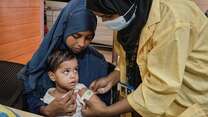
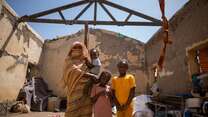
Mweramana with son Dieume, daughter Leah, and (right) a young friend. Photo: Emily Meehan/The IRC
Emily Meehan recently joined the International Rescue Committee in eastern Democratic Republic of Congo, where an upsurge of violence has uprooted hundreds of thousands of people.
Goma, North Kivu 22 Dec 08 - After spending three weeks visiting camps for people displaced by the fighting in North Kivu, I must confess that the setting has become pretty normal to me. There are certain constant and predictable circumstances, most notably the mobs of children who surround me and shout a collection of greetings.
There’s “MORNING!” – no matter what time of day it is. “Muzungu,” which means “foreigner” in Kiswahili, comes in two varieties: low giggle, and amazed shout. The kids say “bonjour” of course, and when I say “jambo” for hello in Kiswahili, they respond politely with “jambo sana,” a salutation they jam into one shy word just like small children in the U.S. tend to say “you’rewelcome” in that reliable whisper.
So when I was recently sitting in a tent in Kibati II camp with a small child and I didn’t hear any of this reassuring, spunky noise coming from him, the setting quickly shifted from familiar to silently devastating.
Little Dieume, whose name is abbreviated from Dieu Merci, or “God’s thanks” in French, is three-and-a-half. But unlike most kids who have reached such a phenomenally mature age, he didn’t care to tell me about it, or about anything else for that matter.
“He’s not healthy,” said his mother, Mweramana Sebasigari Verdiane. Both times I met Dieume, Mweramana pointed to a hardened ball of corn pudding that he had discarded. “He misses the food he was used to having. We had goats, cows, hens, vegetables,” she said of their old life and meals.
Dieume and his family have been displaced twice in the past few months. They had lived their whole lives in the village of Kanombe, not far from the IRC field office in Rutshuru territory. But at 5 o’clock one morning last September, armed men came through town, shooting and burning down the houses.
Mweramana and her family of six ran to nearby Rumangabo, where they settled in a camp until fighting drove them out again, all the way to Kibati, outside of the provincial capital, Goma. “The war is making us suffer,” said Mweramana. (It was through the IRC’s
recent distribution of sanitary materials in Kibati that I met her family.)
I walked with Mweramana and her youngest to the health clinic at the Kibati II camp to see if the staff there would be able to advise her on why Dieume wouldn’t eat.
When Mweramana got the attention of a nurse , the woman and her assistant looked incredulously at the chubby toddler. The assistant gripped Dieume’s upper arm to measure its circumference. “He isn’t suffering from malnutrition,” said the nurse. She gave Mweramana some flour to add to Dieume’s porridge to try to improve his appetite.
Before we left the clinic, Mweramana noticed her son had lost one of his shoes. She spoke to him in their native language, Kinyabwisha, but he didn’t respond.
The look on Dieume’s face was apathetic—more than I thought possible for a toddler. I wondered if he was traumatized as I looked around the crowded waiting area for a small blue flip-flop. If I lost one of my only two shoes, wouldn’t I say something? I don’t know. I might be tired if I had just spent the past three months eating corn pudding and moving from one camp to the next with gunfire behind me. A lost shoe? Oh well. More corn pudding? No thanks.
I went to see an IRC colleague who works with children in North Kivu to find out what can be done to help kids who’ve stopped eating and smiling. I was still shocked as I explained Dieume’s behavior, but Lisa Bender was not.
“Children who are traumatized need normalization and routines,” Lisa told me. That means a chance to go to school. “Schools provide safe places for children to be with adults who they trust,” she said. She explained that going to school also helps children build the skills they need “to make better choices in life and realize their full potential—even in difficult times.”
The IRC is supporting 40 primary schools in Dieume’s community, training teachers, providing school supplies and emergency plans, rehabilitating and furnishing classrooms, and even building school latrines. We’re also supporting local youth groups and running awareness campaigns that urge parents to send their children to school.
You can give a holiday gift to children in North Kivu by
supporting our Congo programs.
Special note: Your gift will be matched dollar-for-dollar through December 31