International Rescue Committee (IRC)

VOICES FROM THE FIELDTHE IRC BLOG

"They Said Bhutan Was Their Country, Not Ours"


Purushottam Ghimire

Purushottam Ghimire (right, with his family) has lived his entire adult life in a refugee camp. Photo: Peter Biro/The IRC.

The IRC’s Peter Biro is reporting from Nepal, one of the world’s poorest countries. Despite a 2006 peace accord that ended a decade of civil war, and elections that will help determine the country’s future, life is a daily struggle for most people in the Himalayan nation. Read all of Peter's posts from Nepal here.

Purushottam Ghimire, 30, has lived in quiet desperation for most of his adult life. Surviving on humanitarian food rations, he is unemployed and unable to leave the confines of Goldhap, a camp in eastern Nepal that houses nearly 10,000 of the country’s 108,000 refugees from Bhutan.

“It’s not a good or interesting life we have here,” he contemplates as we sit down over a cup of tea under a blue tarpaulin flapping in the wind. “We have neither Bhutanese nor Nepali citizenship and we are not allowed to work. All of us here have become inactive and depressed.”

In the early 1990s, the Bhutanese government began expelling its citizens of Nepalese origin, known as Lhotsampas. Seen as a demographic and cultural threat, the authorities stripped them of their citizenship and drove them from their homes in a brutal campaign of ethnic cleansing. They now live in seven refugee camps in Nepal’s eastern Jhapa district.

As another cup of tea is served, Purushottam tells me that he was 15 years old when his family was driven out of their home in southern Bhutan. He still remembers the harassment and abuse they suffered at the hands of the authorities before they were expelled.

“We were threatened by the Bhutanese army many times before they finally chased us out,” he recalls. “They said that Bhutan was their country, not ours. And if we didn’t leave they said that they would set fire to our house at night while we were asleep. Soon after, they torched some of the nearby houses and we decided to leave for good.”

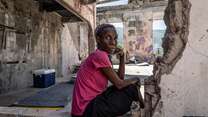
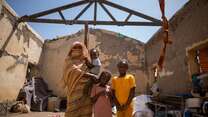
The camp is gloomy, its pathways muddy and the majority of the inhabitants are squatting under plastic sheeting after an accidental fire roared through Goldhap a month ago. Most of the refugee homes were destroyed along with a camp school. All that remain is a veritable forest of concrete pillars and charred wooden planks. The International Rescue Committee helped with hygiene kits, clothing and emergency supplies after the disaster.  

On 1 March, a fire at the Goldhap camp destroyed nearly 1,300 out of 1,500 houses. All that remain are concrete pillars and charred wooden planks. “The fire just added to our desperation,” Purushottam Ghimire says. Photo: Peter Biro/The IRC.

On 1 March, a fire at the Goldhap camp destroyed nearly 1,300 out of 1,500 houses. All that remain are concrete pillars and charred wooden planks. “The fire just added to our desperation,” Purushottam Ghimire says. Photo: Peter Biro/The IRC.

“The fire just added to our desperation,” Purushottam says. “Under normal circumstances, it’s hard enough to survive. Since we can’t work, money is always a problem. If someone in the family gets sick or there are any other unforeseen costs, we have a big problem.”

Prohibited from working, some refugees have the possibility to volunteer as teachers and health workers in the camp. For this they are paid what is called incentives, which is lower than a normal salary. Most refugees, however, just kill time, Purushottam tells me.

“Sometimes people leave the camp and find small jobs in the local informal sector. But most of the time we play cards, drink homemade alcohol and wait for humanitarian rations.”

Despite these dire conditions, Bhutan has not allowed a single refugee to return and no prospects for a solution are in sight. Recognizing the predicament of the refugees, several western governments have pledged to resettle the Bhutanese, with the United States offering to receive about 60,000, which is almost half of them. In addition, thousands of refugees will get the chance to resettle in Canada, Denmark, the Netherlands, New Zealand and Norway.

Once they reach the United States, the IRC is one of nine humanitarian organizations that will resettle the Bhutanese across the country, helping them find housing, employment and access to English language instruction and health services.

But since the announcement of the resettlement offer, tensions in the camps have been building because of rumours and misinformation about the nature of the offer itself. Some of the refugees also tell me that they have been intimidated by groups militantly opposed to resettlement who insist that the only acceptable solution is return to Bhutan.

“But we hope that the tension will ease as the resettlement applications are growing,” says Hari Adhikari, another of the camp inhabitants I meet outside the Goldhap school. “Of course we all want to go back to Bhutan – some of us have property that we had to leave behind – but the government will never take us back.”

Before I came here, Christine Petrie, the deputy vice president of resettlement with the International Rescue Committee, told me that resettlement in a third country is typically the very last option. But that for the Bhutanese, there is simply no other solution.

Purushottam Ghimire agrees. He has already applied for resettlement in the United States along with his family of five. Although the thought of never seeing his home country again is saddening, Purushottam says he is very eager to go. At the same time, he has no illusions that life in a new country will be easy.

“It will be very hard and a lot of competition for jobs,” Purushottam predicts. “I have no idea what life in the United States will be like, but I have to try. I can’t go on living like this.”


3 comments

Comments

Mr. Drukstylz, You need to

Mr. Drukstylz,

You need to study more on the type(s) of people living in Bhutan and their role in making modern bhutan. Bhutan govt. have not given justice to the southern and eastern Bhutanese in terms of equal rights. You cannot have 130000 illegal immigrant in a country where a population is just over 700,000. I am from Bhutan and my great grand father was born in Bhutan and I am a citizen of Bhutan by birth as you and as everyone else.
We will definetely be back to our home land some day and with the change we believe from the autocratic regime of Bhutan.

The Nepali Refugee Issue is

The Nepali Refugee Issue is resolved. 60% are being relocated to America, with the rest going to various third party countries such as Netherlands, Australia and Scandinavia.

I'm glad that this issue is

I'm glad that this issue is sorted out. Its really been a blemish on Bhutan's otherwise outstanding record. Although I think the situation was magnified by the sheer incompetence of UNHCR in verifying who were authentic refugees and who were people looking for hand outs.

Post new comment

The content of this field is kept private and will not be shown publicly.
Image CAPTCHA
Enter the characters shown in the image.

ABOUT THIS BLOG        COMMENT GUIDELINES        DONATE        ARCHIVE