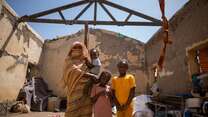
Since 1933, the IRC has provided hope and humanitarian aid to refugees and other victims of oppression and violent conflict around the world.
The IRC on Twitter
-
@LCO_orchestra @RiyadNicolas @cadoganhall Hope it's an amazing night! Thanks for your support.
May 17, 2013
-
RT @DCComics: Amazing. 2.6k of you gave $150K+ to #WeCanBeHeroes. Big thanks from DCComics @SavetheChildren @mercycorps @theIRC t.co…
May 17, 2013
-
Cyclone Mahasan update: It spared Myanmar almost entirely, and the storm’s impact in Rakhine State was minimal.
May 17, 2013
-
Cyclone Mahasan update: Storm weakened & then dissipated Thurs, causing far less damage than had been feared as it passed over Bangladesh.
May 17, 2013
-
Call Senate Judiciary Cttee & urge them to pass #CIR that includes protections for asylees & #refugees: t.co/4OQrSoAGVt #CIRmarkup
May 16, 2013
VOICES FROM THE FIELDTHE IRC BLOG
Thinker’s Beach - Ann Jones in Liberia
January 7, 2008
By The IRC
Beautiful beaches within sight of Monrovia seem a world away from the wreckage of war. Photo: Ann Jones |
The International Rescue Committee is working with women's advocate Ann Jones to help women in war zones — survivors of conflict, displacement and sexual and domestic violence — use photography to make their voices heard. Ann is blogging the year-long project from West Africa. If you're just joining us, you can read her first series of posts from Cote d'Ivoire at theIRC.org/16days.
The story continues in Liberia, where Ann is posting updates and new photos on Mondays and Thursdays.
Monrovia, Liberia If you read my blog during the 16 Days of Activism Against Violence Against Women (November 25-December 10), you know about the new Gender Based Violence project we call “A Global Crescendo: Voices of Women from Conflict Zones.” We lend women digital cameras and ask them to document their lives. The photographs put in sharp focus a lot of “bad, bad things” and turn the photographers into advocates for change.
After spending six weeks in Cote d’Ivoire, I’ve moved next door to Liberia, the second stop on our year-long agenda. When my flight from Abidjan landed in Monrovia, I was still high on the changes bold Ivoirian women had made in so short a time. The Cote d’Ivoire story was a tale of transformation. That sounds pretentious, but it’s true.
The drive from the airport to central Monrovia brought me down to earth: wretched roads, paltry markets, ruined houses, blackened shells of government buildings occupied by long-term squatters, and the sprawling home of former big man Charles Taylor bearing a message inscribed in Christmas lights, now extinguished: “Season’s Greetings.”
When an IRC colleague invited me, I escaped to the beach.
It was splendid and wild. The pale sand. The pale sky. The sea the color of silver foil, crashing over a bar not far offshore. I stepped in to the water just as a wave rolled back, sucking sand from beneath my feet. The rip caught me and hauled me far down the shore before I found my footing again. So much for swimming.
I told my colleague I’d take a nice long walk on the beach. “Please, not,” she said. She had warned me about the treacherous surf, and now the sand: “Some women have been raped. Men have guns. Friends can do nothing.”
A small street market serves squatters—mostly former soldiers—who live in the ruins
of the massive building President Charles Taylor built to house the Ministry of Defense.
Photo: Ann Jones
These children live in the wreckage of the Liberian Broadcasting System building—without water,
without toilets or latrines, without electricity—and after five years or more, without much hope.
Children of war, they have never known another life. Photo: Ann Jones. |
Comments
It is sad as my friend
It is sad as my friend said
when we see the kind of life in war zones.This remind us off what some of us whent through
hope some staff like Felishia is there,you who is reading this and have a way of helping these pleople do it this is the time
" Life it more than any thing"
Do not marry with
Do not marry with foolishness. There may be children.
I'm a London based
I'm a London based documentary maker researching a documentary about the relationship between UN peace-keepers and local women. Obviously this is a big and complex question, with overlap with some of the issues Ann is highlighting.
I'm really impressed with the work Ann is doing with Liberian women, (especially the self-documenting) and the importance of getting these stories heard. In the course of my reserach I am seeking to get in touch with Liberian women and/or local women's groups. I'm especially interesting in hearing stories that are related to their contact with the peace-keepers.
congrratulations Ann on your work. If you or anyone else at IRC or elsewhere has any leads, stories or contacts for me I would really appreciate you getting in touch and sharing these with me. I'm also happy to talk more about my film-work and this project.
Many thanks,
Maxx Ginnane
I was the consultant who
I was the consultant who conducted the survey among Liberian refugees in Sierra Leone. I have some excerpts from the report if you're interested.
Dear Ann I really appreciate
Dear Ann
I really appreciate your effort and determination to keep going. It's very encouraging to see your commitment towards ending violence and empower women of conflict zones. Keep going, you will surely reap the harvest you are sowing now. let peace prevail even in conflict zones.
Thank you, everyone, for your
Sammy - thanks for your
Sammy - thanks for your interest in volunteering. The IRC Web site contains information about volunteer opportunities: www.theIRC.org/volunteer
Laura -- thanks for your
Laura -- thanks for your question about the two studies. Ann is in the field, so I referred it to an IRC colleague in the GBV program at our New York headquarters. She said that the Columbia/IRC report on GBV in Liberia will be published soon. As for the WHO, the assessment is here but you can look on the WHO Web site as well.
The figures you cite are
The figures you cite are tragic. I would like to read more about these studies. Could you please provide the references for the IRC/Columbia study (2007) as well as the WHO study (2005)?
Thank you
its sad inhumany and ungodly
its sad inhumany and ungodly to what happened in liberia and I feel it what is happening in my country Kenya .personaly I am a witnes of the war its realy bad.
thank God for IRC and the servant heart they have please continue transforming humany lives for your loves is the basis of judgement.
can you link to the Kenya i would like to volunteer
sammy Kenya
Well, we could donate to IRC
Well, we could donate to IRC and raise awareness of this project. Or help out at women's shelters in our own neighborhoods.
Also we can support the work of IRC through the search engine http://www.goodsearch.com for free.
Looking forward to Ann's latest post!
Any way people can serve as pen pals or provide written encouragement to those in the Ivory Coast or Liberia or anywhere else seeking to create change within their countries? Just human-to-human, rather than sponsored by a government or group.
what can we do ? This is my
what can we do ? This is my question.
I was away over the holidays
I was away over the holidays and not able to keep up with your project. I am glad you are continuing in Liberia. It appears there might be even more need there then in the Ivory Coast. Thank you for this first installment from Liberia. My wife and I here in St. Louis, MO have been working with a Liberian man and his two sons. They came here fleeing the three wars you chronicle in your artilce and after spending many years in Sierre Leone in refugee camps. Blessings on your work with the women in Liberia...keep planting the seeds of transformation...and giving hope!
Peace, Tom
I just hope it works out as
I just hope it works out as well as it did in Cote d’Ivoire
This is so sad. I admire the
This is so sad. I admire the strength that many of these women seem to find to keep moving on however, I feel they have no choice but to move on. As a rape survivor myself I can only imagine what it must be like for these women who are abused several times or constantly by their husbands. I survived and through counseling got back my livelihood. These women do not have any resources and have lost their livelihood. They don't live - they just exist and this is just awful! I will continue to support your cause in any way I can and will forward on your blogs to everyone I can think of.
Thank you for all the hard work you are doing to help these women and children and for helping to spread the word and this awareness out to people around the world.
May we one day find a way to live in peace and harmony.
Its horrible to know the
Its horrible to know the condition and the situation over there. Even we, in the developing countries, are scared for price hike and other related things but unfortunately if we think of the situations like in Liberia, we must feel to be in heaven while only fighting for material things.
I think, it is and will always be order of the day to help and eradicate such crimes against human beings. Its need to help the humanity and protect it.
Can't say any thing else but just " do some thing" because if its not now then it won't be ever.
Regards,
Muhammad Shoaib
I so appreciate your
I so appreciate your reporting on your one-year tour. I wasn't aware of how the violence and rape-violence against women went on and on after wars "officially" ended. The lives of these women must be so fearful and miserable. Women are the emotion-keepers of the human species. Women are tender and soft. They carry and raise the children - both girls and boys. How is it that the men in these conflicts can live with terrorizing, assaulting and raping the very women that are their mothers, sisters, daughters, wives and friends... the very women that raised them? How large a deficit must these men have in their souls to destroy the most important fabric of their societies. I'm strongly in favor of an international consortium on this severe problem with resolutions to put into place policing and judicial structures to take these men out of the general population, and I believe this must be a system that is set in place for good.
Hi Ann, I'm 22-years-old and
Hi Ann,
I'm 22-years-old and recently returned from Liberia, where I spent the Christmas holiday. I volunteered with the MacDella Cooper Foundation, which supports orphans and abandoned children in Liberia. We had a huge Christmas party for 4 orphanages. I blogged about it on http://newyorktoliberia.wordpress.com. I admire your writing style and I completely relate to what you're conveying -- I feel like you're putting into words what was indescrible to me. I will be reading each blog update eagerly.
~Tammy
I grieve for all the people
I grieve for all the people of Liberia and now Kenya. It's impossible for me to imagine what it's like to live with war for all those years. Thank you again for your work. It's vital that we in the U.S. know what is happening in these troubled places.
It's excruciating to see
It's excruciating to see what's happened and what continues. The strength required to survive during such horrific circumstance is inspiring and humbling. When one reads the accounts it takes us there and does deepen awareness...but what to do with it? What can we do to stop the violence from so far away? What are we to do beyond feel about the powerful messages you're sharing? I've seen too many tragedies feed someone's art form. It's a vacuum. I'm not saying your photos fit into that....it just leaves me with a what next?
Post new comment
Voices From...
Contributors


A small street market serves squatters—mostly former soldiers—who live in the ruins
of the massive building President Charles Taylor built to house the Ministry of Defense.
Photo: Ann Jones
These children live in the wreckage of the Liberian Broadcasting System building—without water,
without toilets or latrines, without electricity—and after five years or more, without much hope.
Children of war, they have never known another life. Photo: Ann Jones.