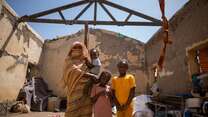
Since 1933, the IRC has provided hope and humanitarian aid to refugees and other victims of oppression and violent conflict around the world.
The IRC on Twitter
-
@LCO_orchestra @RiyadNicolas @cadoganhall Hope it's an amazing night! Thanks for your support.
May 17, 2013
-
RT @DCComics: Amazing. 2.6k of you gave $150K+ to #WeCanBeHeroes. Big thanks from DCComics @SavetheChildren @mercycorps @theIRC t.co…
May 17, 2013
-
Cyclone Mahasan update: It spared Myanmar almost entirely, and the storm’s impact in Rakhine State was minimal.
May 17, 2013
-
Cyclone Mahasan update: Storm weakened & then dissipated Thurs, causing far less damage than had been feared as it passed over Bangladesh.
May 17, 2013
-
Call Senate Judiciary Cttee & urge them to pass #CIR that includes protections for asylees & #refugees: t.co/4OQrSoAGVt #CIRmarkup
May 16, 2013
VOICES FROM THE FIELDTHE IRC BLOG
Touchdown!
May 27, 2010
By The IRC
Refugee teens in Boise, Idaho are taking part in a football camp run jointly by the IRC’s after-school program, the Boise Language Academy and the semi-pro Treasure Valley Spartans football team.
Guest blogger Lucy Carrigan is the International Rescue Committee's media relations officer.
For five Tuesdays this spring, a group of teenagers in Boise, Idaho, have been getting together in the afternoon to play football.
Play football? There’s nothing very unusual about that, you might say. And you’d be right. Except that these kids, even though they are teenagers, have never played football before. They are young refugees who are attending the Boise Language Academy and they are participating in the International Rescue Committee’s after-school program in Boise: the refugee youth football camp. They come from places as far and wide as Iraq, Congo, Bhutan, Burma and Burundi. They have all recently been resettled to the United States and they are in various stages of adjusting to their new lives here.
The football camp was the brainchild of the sports coach at the local YMCA, Dane Knickrehm, who volunteers at the IRC’s after-school programs. He taught the kids basketball and he taught them soccer (“they were way better than me at that!” he says), but realized that they had no experience with American football. In fact, some of them were downright wary of the game.
“When you say American football, they don’t think of catching the ball and running with it,” Knickrehm says. “All they could think of was tackling each other.”
Football is big in Boise and so Dane got to thinking: what better way to help these new arrivals integrate into their local communities than to teach them how to play the game. It would help them learn more about American culture, and, if they liked the game, there was every possibility that when they moved on to their local public school, they could play on the school’s high school team, making their entry into high school life a little bit easier.
He approached Ellen Albus, the youth program coordinator at the IRC’s Boise office and asked her if she would be open to a refugee youth football camp. Ellen, who is always looking for fun and stimulating ways to engage young refugees, said she certainly would be.
Knickrehm plays football for a semi-pro football team in Boise – the Treasure Valley Spartans. He enlisted his teammates to help him coach at the camp. And so they did. Every week between eight and twelve members of the Treasure Valley Spartans took time out of their workday to join the kids out on the football field behind the Boise Language Academy — with an apartment complex to the left and a busy highway to the right — no matter the weather (and it has been cold in Boise this spring), and taught the kids how to play the game.
But it’s not just about getting into the end zone. The young players are learning life lessons on the football field.
“If they are asked to run to a line, they know to run past the line, to give it a 110 percent every time,” Albus says. “The coaches talk about the classroom: just as you have to give everything you’ve got here, you’ve got to try really hard every single day there.” They learn about teamwork, sportsmanship, and as Knickrehm puts it, “being able to look at the guy beside me and trust that person.”
The kids are also just having fun – plain and simple. At home, many are expected to be more adult than befits their age. Because they are attending school all day and are surrounded by English speakers, they frequently speak better English than their parents. For this reason they are often the ones having the conversations with the landlord, discussing the electricity bill or interpreting conversations at the doctor’s office. At the camp, these kids can just let loose and have a ball.
“It’s been one of the most rewarding things I’ve ever had the opportunity to do,” says Knickrehm. Not to mention entertaining. “It’s a great thing to watch these grown men work with the kids, especially when there is a bit of a language barrier.” He laughs. His enthusiasm for the game seems to be infectious. Knickrehm has heard from the school that the kids are now choosing to play football, not soccer, when they are on their class breaks.
The refugee youth football camp has just ended its second year at the Boise Language Academy.
“Here’s to many more seasons to come!” says Albus.
Comments
Wonderful story. Thank you
Wonderful story. Thank you for sharing.
Wow! This story sure smacked
Wow! This story sure smacked me in the face. What a great thing it is, that the Adults take the time to share their expertise with the youth. They should be commended for their efforts, both the adults & youth. This message should be spread through out the country, for it's this kind of events that perhaps inspire others to emulate. Hats off to all.
Post new comment
Voices From...
Contributors