Sign Up
Since 1933, the IRC has provided hope and humanitarian aid to refugees and other victims of oppression and violent conflict around the world.
The IRC on Twitter
-
RT @wrcommission: Ever think cell phones could help protect children's rights? Well they are! Find out how in this new #blog t.co ...
Feb 8, 2012
-
@infoasaid Thanks for sharing that resource. We'll pass it on to our media team.
Feb 8, 2012
-
@winmitch No, it's not the same program. More on our programs in Kenya: t.co/Py9peewR.
Feb 8, 2012
-
Make a difference in the life of a #refugee - volunteer with the IRC in Tucson! Your skills & passions needed: t.co/N6PPdMbM
Feb 8, 2012
-
In #Congo’s massive southern province of Katanga, the IRC's community-driven reconstruction program, ‘Tuungane,’ h t.co/y42qNqLO
Feb 8, 2012
VOICES FROM THE FIELDTHE IRC BLOG
UGANDA: A Night on the Hotline [16 Days]
December 1, 2009
By Joanne Offer
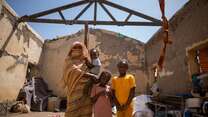
Photo: The IRC
2009 marks the 18th anniversary of the “16 days of Activism Against Gender Violence” campaign.
It’s 2 am when Apio Agnes’ mobile phone rings. She’s suddenly awake and ready to go. It’s her night to answer calls to a 24-hour hotline dedicated to anyone who needs advice or support on rape, domestic violence, sexual harassment or other forms of gender-based violence.
The hotline gives victims and potential targets of violence the chance to talk to a trained professional in confidence.
“I’ve received calls late in the night from women saying ‘my husband has assaulted me’ or ‘he is forcing me to sleep with him’ and they don’t know where to turn,” Agnes says. “Last Saturday, a man called and said his wife was beating him, although I must admit the overwhelming majority of the calls are from women.”
Agnes is one of three staffers on rotation at the International Rescue Committee’s (IRC) center in Kitgum, northern Uganda, trained to answer the hotline. They receive about 140 calls a month and are happy to ring the caller back if he or she can’t afford to stay on the line.
The IRC staffer will comfort the caller and offer counseling and guidance on available services such as medical care, legal support or protection.
All decisions lie with the caller and it’s his or her choice on how or if to take the matter forward.
“Nationally, measures to reduce GBV are not a priority” says IRC officer Gellah Kezzy, “so the hotline provides an invaluable service. We run radio spots to promote it and have handed out hundreds of cards to promote the telephone number.”
The hotline started in 2007 in Kitgum, a district wracked by years of fighting between the Lord’s Resistance Army (LRA) rebel group and the Ugandan government.
More than 1.5 million people were forced to flee their homes and live in displacement camps, where women and young girls in particular were more vulnerable to attack or assault.
A ceasefire was signed in 2006, although the LRA still operate in neighboring Sudan and the Central African Republic.
“Now that there’s peace in northern Uganda and people are returning to their homes, the rising problem seems to be domestic violence,” says Gellah. “Families must rebuild their homes, replant their farms and basically start over from scratch.”
She adds, “It’s a stressful time. Especially since the drought has destroyed many harvests this year – and it seems people are lashing out.”
This situation is made worse by a lack of knowledge about human rights in many communities. “Many women feel that, if the man is supporting the family, they don’t have the right to say no to him,” Gellah explains. “We are trying to change that.”
The IRC is also empowering local organizations to tackle the problem to create lasting change. We are delivering training in the technical aspects of GBV, for example, how to counsel a survivor of sexual assault. We also provide training on day-to-day operations such as finance, human resources and logistics.
“We are working with groups who share a vision with the IRC and who can gradually take over programs like the 24-hour hotline,” Gellah says. “As northern Uganda moves out of an ‘emergency’ phase, it’s more important than ever that local people and local organizations are spearheading the process going forward.”
For now, however, Apio Agnes and her colleagues will continue to man the calls while local partners get up to speed.
“It’s a marvelous feeling when we help someone,” says Agnes. “We helped one woman who’d been pressured into sex and assaulted to move to another district where she felt safe. That’s what we are here to do.”
Comments
Hi there, am really impressed
Hi there, am really impressed with the idea of the 24 hr hotline dedicated to Survivors of GBV. I used to work for IRC in Kitgum in the Psychosocial Program and i attended a training of trainers on how to communicate with survivors of GBV, it was the best training i had & i was able to impart the knowledge i acquired to other service providers. I think you have a brilliant idea about this hotline as it empowers the vulnerable & makes them feel cared for. I believe it gives a Positive Mental Attitude(PMA) to survivors especailly in the case of abuse. Well done, i will recommend your work & effort to other service providers & try to keep people off prescriptions for anti-depressants, i think talking to a professional person helps in the case of GBV. Am very impressed, well done, give each one in your team a part on the back, you are great & amazing people. Keep it up. Ta. XX
Post new comment
Contributors