After a bomb took her son's hearing, a Syrian mother goes to Europe to try to get it back
September 29, 2015 by The IRC
|
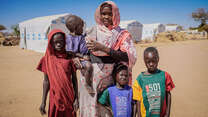
| Ali, 4, and his parents at the Kara Tepe transit camp on the Greek island of Lesbos. The island is an entry point for many Syrian refugee families on their long journey to seek safety and a new start in Europe. Photo: Tyler Jump/IRC |
Four-year-old Ali* recently arrived on Lesbos with his family after safely making the treacherous sea crossing from Turkey to the Greek island. He’s one of the thousands of people fleeing violence in Syria and other countries in crisis who are landing on Europe’s shores each day.
In 2011, when Ali was only five months old, a bomb fell from the sky and struck his home in Aleppo, one of Syria’s most war-ravaged cities.
The blast left the baby with severe nerve damage that would affect his hearing.
“The bomb exploded near him,” said Ali’s mother Fatima. “He was so afraid. The doctors said that he can’t hear anymore, and he can’t speak.”
With little Ali tucked in her arms, Fatima fled with her husband, a construction worker, and their older son to neighboring Lebanon, where she hoped the baby could get surgery for his ears and the family could live in peace. But they struggled for three years to find a doctor who could perform the procedure Ali needed. Also, they found that the costs — at least $40,000 — were still far out of reach.
“We came [to Lebanon] to get help,” Fatima said. “No one could help us.”
![]() | |
| Ali and his older brother at the Kara Tepe camp, where the IRC provides water, sanitation and information about the registration process to obtain travel papers. Photo: Tyler Jump/IRC |
Fatima knew that the longer Ali had to wait for surgery, the less likely it would be that his hearing could be restored. “As he gets older, his situation gets worse,” she explained.
With time running out, Fatima and her husband decided to risk the sea journey to Europe, where they had heard Ali would have a better chance of getting help. They traveled to the Turkish coast and borrowed $4,600 from friends to pay a smuggler to carry the family across the Aegean to Lesbos in a flimsy rubber dinghy.
Fatima says she wasn’t afraid during the turbulent, six-mile crossing: Her hope for a brighter future for Ali kept her going.
“When I challenge the bad weather, the bad sea, and I challenge death, I do it only for my son.”
After the exhausted family made it ashore, the International Rescue Committee provided them with water and information about how to register at a camp outside Mytilene, Lesbos’s capital, where they waited for their travel papers to continue their journey north.
Their destination? Any European country that will offer Ali the surgery he needs to get better.
![]() | |
| “When I challenge the bad weather, the bad sea, and I challenge death, I do it only for my son," Fatima says. |
Although she’s heard that many families like hers have received a warm welcome in Europe, Fatima knows about the obstacles others have faced trying to cross some of its borders. She worries that roads will be closed and doors shut against them—but she remains undeterred.
“For four years I fought for my son to come here,” she said. “Nothing will stop me from finishing this mission and helping my son.”
Refugee Crisis
More than half a million refugees and migrants from Syria, Afghanistan and other countries in crisis have fled to Europe this year, and most have arrived on Greece’s eastern islands. Aid workers with the International Rescue Committee have been providing critical aid and services on Lesbos, which has struggled to cope with the massive influx of up to 4,000 refugees arriving daily. Learn more.
*Last names have been omitted for the family's protection