Women line up to collect sanitary kits in Kibati II camp outside of Goma. Photo: Emily Meehan
Emily Meehan recently joined the International Rescue Committee in eastern Democratic Republic of Congo, where an
upsurge of violence has uprooted hundreds of thousands of people.
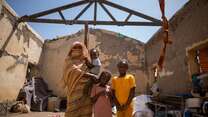
Goma, North Kivu, Eastern Congo When the International Rescue Committee’s sexual violence response team recently assessed the needs of women living in the Kibati camp for displaced people, on the edge of Goma, they heard devastating accounts of rape. Sexual violence is a weapon of war in eastern Congo and a daily reality of displaced life – armed men are raping women and so are strangers who live in and around the camp.
My colleagues started their work in Kibati by simply asking women about their needs and problems. They build trust. They are careful and discreet. And when women disclose stories of rape, they are referred to psychosocial and medical services. They are accompanied and supported through the process.
In the course of the Kibati assessment, women told my colleagues of other problems as well. They have no underwear, no sanitary materials to use during menstruation. And so we respond to this, too. Sarah Spencer, the IRC’s coordinator of programs that address sexual violence, kicks her team into high gear to provide those women with the most basic of needs.
“Giving women sanitary materials helps restore dignity despite the devastating situation around them, and helps to promote basic hygiene and health,” Sarah says. “Every woman of reproductive age needs this.”
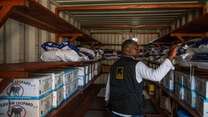
I follow Sarah’s team through the process of assembling 9,000 sanitary kits, learning that in Congo women use pagne, the colorful, patterned cotton fabric used to make most clothing here. (Pagne is a story in itself – in the last week, I have seen a nurse wearing “Florence Nightingale” pagne and a journalist wearing “Radio” pagne.) Women cut the fabric into strips when their clothes wear out and layer the strips to use like a sanitary pad. Along with new pagne, the IRC prepares to distribute buckets, soap, underwear, and flashlights – to help keep them safe in the camp after dark.
After assembling kits, Sarah’s team starts the large task of registering women and handing out pink and yellow coupons to every woman 13 years and older, about 900 total in the first part of the camp.
The distribution finally starts on a cloudy Wednesday, when I learn that this area, called Kibati II, is a serious trek. After reaching the edge of Goma, our driver turns into the first sprawling camp at the foot of the Nyiragongo volcano. Then we wind through an overgrown banana and bean plantation on a torn-up, muddy track for 25 minutes – to go only four kilometers. “That’s where the driver got stuck yesterday,” someone says, pointing to one chasm we avoid.
Women and girls in Kibati II line up and wait patiently for up to two hours, hardly making a sound. Several IRC trucks had brought the inventory, and eight IRC staff members set up stations to verify and stamp coupons. Day laborers in bright orange traffic vests pass colorful buckets off the trucks to the women. The IRC team had decided to consolidate the items in the buckets, which women could then use to collect water and wash.
In the crowd are shy, young girls and women who have already seen their children grow up through both peace and war in their lifetimes. Joviale, one of my colleagues, makes use of the hours of waiting to talk to women about health and psychological services available in the camp, as well as the importance of seeking out health care within 72 hours after rape. A short distance away, a community elder wearing a USA sweatshirt stands by with a megaphone and tries to calm playful children.
The distribution is remarkably peaceful, my experienced colleagues tell me. No armed groups shoot at each other nearby, and the rain holds off until we finish.
I follow the Kibati II’s female camp president back to her hut to watch her unpack the items in her bucket. The camp pastor, impeccably dressed in a three-piece suit, writes her name in my notebook: Mweramana Sebasigari Verdiane. As Mweramana pulls out soap, batteries, fabric, underwear, a flashlight, and a laundry line, she smiles and offers me a seat in her warm 6-by-10 foot hut. Two of her four children are with us, and the smallest sidles up next to me.
Dieume seems like a sad child. “He doesn’t eat,” says his mother. She opens a basket to show me a ball of fou fou, the African corn pudding that’s often the only food available to displaced families. Dieume’s discarded meal doesn’t appeal to me either. I try to talk to him, but he doesn’t seem interested. The
two-year-old three-and-a-half-year old hugs himself with his arms, his head hung down, eyes defeated.
Sitting in this small hut I forget the cheer of the sanitary kit distribution and remember why we’re here, why so many people are living in a congested camp. There is this war that has stretched on too long. Mweramana and Dieume were driven from their home, as were their relatives and neighbors. They lost everything. They’re hungry. I think of what Sarah said about dignity. I think of all that’s been jeopardized, and all we still have to protect.
Next from Emily: Meet
Dieume >
[gallery]