Sign Up
Since 1933, the IRC has provided hope and humanitarian aid to refugees and other victims of oppression and violent conflict around the world.
The IRC on Twitter
-
RT @wrcommission: Ever think cell phones could help protect children's rights? Well they are! Find out how in this new #blog t.co ...
Feb 8, 2012
-
@infoasaid Thanks for sharing that resource. We'll pass it on to our media team.
Feb 8, 2012
-
@winmitch No, it's not the same program. More on our programs in Kenya: t.co/Py9peewR.
Feb 8, 2012
-
Make a difference in the life of a #refugee - volunteer with the IRC in Tucson! Your skills & passions needed: t.co/N6PPdMbM
Feb 8, 2012
-
In #Congo’s massive southern province of Katanga, the IRC's community-driven reconstruction program, ‘Tuungane,’ h t.co/y42qNqLO
Feb 8, 2012
VOICES FROM THE FIELDTHE IRC BLOG
Hurricane Katrina, 2005: A refugee helps America's displaced
IRC caseworkers Elhamija Kadic (right) and Meliha Bosnjak, former refugees from Bosnia, place an order for mattresses for Katrina evacuee families' new homes in Atlanta.
Elhamija Kadic fled war and persecution in Bosnia in 1992 and came to the United States with the help of the International Rescue Committee (IRC). Today she is a U.S. citizen and works for the IRC in Atlanta helping other refugees from war-torn countries. When Hurricane Katrina struck the Gulf Coast in 2005, she helped coordinate the IRC's response. She spoke with me last week about that experience:
How did you feel when you heard that victims of Hurricane Katrina were going to be relocated to Atlanta?
I never imagined that one day I would be helping people displaced inside the U.S. I knew they were in great need. I wanted to help and to pay back because, really, so many generous people had helped me, my family and other refugees.
Was the Atlanta community welcoming?
Yes, they were helping out even before the families started to come.
Tell us about some of the people you helped. What did you do for them?
I met a family from Louisiana at the bus station, the Parker family. It was very crowded. I didn't know what they looked like, and I started to call their name. And then I saw a really smiling face. It was Temika Parker with her children - four very, very beautiful girls. We greeted each other and I told her that I was there to welcome them and to take them to their apartment.
The apartment was set up with donated furniture and rent was paid for six months. IRC volunteers and mentors helped with food, clothing and other resources for the family. Later on we helped with immunizations and registering the children for school.
We also worked on finding a job for Temika or her boyfriend. After several months, her boyfriend got a landscaping job through one of our volunteers and started to support the family.

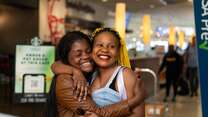
Elhamija Kadic (left) and Temika Parker with Temika's four daughters
and some of their new neighbors -- young refugees whose families were
resettled in the U.S. with the IRC's help. Photo: Louisa Assibi/The IRC.
Are you in touch with Temika and her family today?
Yes. Things were up and down for the family for a while. They came to the IRC several times for help. They were thinking about going back to New Orleans -- but when I was with Temika a few months ago, she had a good job and housing, and her children were in school. They really had become part of the community -- so she is settling in Atlanta.
What did you learn from responding to the Katrina disaster?
I learned that everybody might be in need in some way -- and that everybody needs to be prepared to ask for help. We definitely don't know what the future will bring us.
What does someone need to succeed when they start over in a new community?
I think that it's very important to be open-minded and to be open to learn. That is somehow a key for success. And to look forward, not to look back.
People working together can succeed at whatever they want to accomplish. The IRC in Atlanta has a great, supportive team. Everybody's on the same mission: creating opportunities for refugees to thrive in the U.S. And we are willing to really help people and lead by our example.
Atlanta was among the U.S. cities most affected by the arrival of evacuees from the Gulf Coast. During 18 months of operation, the IRC's Atlanta program distributed $350,000 in direct assistance to 1,300 evacuees and matched volunteer mentors with over 200 affected families.
This interview was first published by Associated Content from Yahoo.
No comments yet.
Contributors


Comments
Post new comment