Since 1933, the IRC has provided hope and humanitarian aid to refugees and other victims of oppression and violent conflict around the world.
Recent Posts
The IRC on Twitter
-
RT @MoveEndViolence: Why do we need a #movement to end #VAWG? #MovementMaker Heidi Lehmann of @theIRC on the blog. t.co/H74c80BdAs
May 20, 2013
-
@Doylech @oneworldadopt @Just_Naomi_chan @socialfund @AFRIpads @tamaraduker @lynndalsing @HuTerra @scribblymouse thanks for your support!
May 20, 2013
-
RT @IRCuk: Thanks @LCO_orchestra @RiyadNicolas @cadoganhall for an excellent concert & for supporting our work w. Syrian refugees #TheAsfar…
May 20, 2013
-
Call members of Senate Judiciary Ctte & ask them to retain #CIR provisions that protect refugees & asylees t.co/xLIoPRWloc #CIRmarkup
May 20, 2013
-
#CIRmarkup: Sec. 3405 of U.S. #CIR bill is in markup right now. It contains important protections for #refugees, asylees & stateless people.
May 20, 2013
VOICES FROM THE FIELDTHE IRC BLOG
New refugee camp in Jordan striving to support Syrian influx
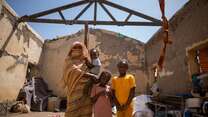
A father carries his daughter through the Za'atri refugee camp in northern Jordan. The new camp currently houses close to 6,000 Syrian refugees, but is capable of expanding to accomodate more than 100,000. Refugees have been complaining about conditions at the camp.
To call the conditions harsh is an understatement. Worst is the sand that billows in yellow clouds through the desert camp, at times limiting visibility to less than 50 yards — the dust is so thick you can almost chew it. Some six thousand Syrian refugees are now housed in Jordan’s Za’atri camp, where the Jordanian government and the United Nations are racing to improve conditions. It has been extremely difficult. Carved out of a patch of desert, there’s an almost constant wind that blows sand across the camp and into tents. When refugees leave their tents, they often do so with their head wrapped in a wet towel, the better to filter out the blowing sand.
Media reports are frequently negative, quoting camp residents who complain that conditions are worse than those they fled in Syria. It got so bad this week that at one point Jordanian riot police were called when camp residents attempted to leave. But the camp is a work in progress, and day-by-day conditions are improving. The white tents emblazoned with the blue UN refugee agency logo flap in the stiff wind, but are staked down tight. Gravel has been laid down on paths, and roads will be paved later this week.
Refugee numbers increase
Until two weeks ago, almost all refugees who’d crossed into Jordan since fighting began in Syria 17 months ago chose to live in apartments. But as the refugee trickle increased to a flood this summer (at the peak more than a thousand Syrians crossed every night), housing stock tightened up, and rental rates more than doubled. The Jordanian government determined there was no way of knowing where the influx might stop; there was no alternative but to open a tent camp.
Harsh camp conditions improve
While the United Nations acknowledges the tough conditions at the camp, it promises daily progress. Currently, hot meals are delivered by van to the refugees, but as the camp infrastructure improves in the coming weeks, camp residents will be able to cook their own food. They’ll have access to medical care, emotional support, education, water, and even a playground for children. The United Nations is intending to further improve living conditions by replacing the tents with containers as they become available. When the conflict in Syria ends, the plan would be to make further use of the containers — by sending them to Syria as temporary housing for those whose homes have been damaged in the fighting.
The International Rescue Committee’s approach
Today, four in every five Syrian refugees in Jordan are still living in urban areas near the northern border with Syria. These are the refugees the IRC has been working to support since the start of 2012. But the IRC’s deputy regional director says he’s hopeful of expanding programming to the Za’atri camp as well. “We intend to respond wherever the needs are most acute,” says Luan Meraku. “We’re in frequent contact with other humanitarian organizations and the Jordanian government, to ensure we get the most appropriate support to where it’s needed most.” The IRC has already provided primary care treatment to close to a thousand refugees out of our two health clinics in the order cities of Ramtha and Mafraq. In the coming weeks, we hope to begin offering psychosocial support to women and girl refugees. A pair of assessments by the IRC point to the direct targeting of women and girls in Syria by violence. Refugees say it’s one reason so many females have fled Syria. We’re also providing hygiene supplies and bedding to new refugee arrivals.
Learn More
No comments yet.
Voices From...
Contributors


Comments
Post new comment