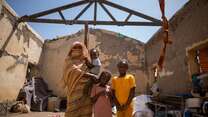
Nadar Hussain lives with his wife, Chaudery, and their seven children in Kot, a town located in the Khawara Valley of Pakistani Kashmir.
Photo: The IRC |
Nadar Hussain lives with his wife, Chaudery, and their seven children in Kot, a town located in the Khawara Valley of Pakistani Kashmir. Nadar worked as a gardener in Islamabad until he was forced to retire 22 years ago to receive a large severance needed for a family emergency. Since retirement, the Hussains have mostly relied on Nadar’s 1,500 rupees ($25) monthly pension to survive. They also earn a small amount of money cutting grass and growing corn on their small plot of land. The yearly corn crop is minimal, and typically yields only three bags of corn (150lb per bag) worth 1,300 rupees ($21). Illness has taken a heavy toll on the Hussains’ income. Nadar has tuberculosis. His children are between the ages of 15 and 30. The four oldest sons are disabled. The two oldest sons are purblind, which means they cannot see at night. The third son is deaf, and the fourth is epileptic. Only the two youngest sons can earn a wage laboring, and the daughter remains at home. When Nadar gardened in Islamabad, he could afford to send his children to school. However, after Nadar’s retirement the family needed the small wages the youngest sons earned laboring, which ruled out attending school.The Hussains lived in a small two-room house with Nadar’s brother, the brother’s wife and their four children, until the October 8, 2005 earthquake that devastated parts of Pakistan. The earthquake destroyed the house and left everyone homeless. Fortunately, no one was hurt because everyone was outside helping to harvest corn. When the Earthquake Reconstruction and Rehabilitation Authority (ERRA), a Pakistani government agency, assessed the damage and disbursed compensation for building a new house, the money was given to solely Nadar’s brother. A family dispute kept Nadar and his family homeless. The IRC approached the Kot community about building a house for a vulnerable family as part of a larger multi-sector rehabilitation project funded by Stichting Vluchteling, the Dutch refugee foundation. The community chose the Hussains. The IRC built a house to shelter the Hussains and demonstrate earthquake-resistant construction techniques to the community. The Hussains were the perfect choice because their need was great and their land was close to the main road in Kot. Construction began in June 2007. Nadar provided 16,000 rupees ($266) worth of wood and materials, and the IRC provided the remaining 296,000 rupees ($4,933) needed. The IRC contracted masons in September to ensure the house was built before winter. “Everyday during construction, people visited the house to learn building techniques,” Nadar says. These techniques included cinder-block and brick placement and steel reinforcement to make the house earthquake-resistant. Today the freshly painted house provides a safe home to Nadar’s family, allowing them to focus on a livelihood, instead of seeking shelter. “We were too poor to build a house, yet now through IRC’s help we have this house,” Chaudery says beaming with pride. |
|