Since 1933, the IRC has provided hope and humanitarian aid to refugees and other victims of oppression and violent conflict around the world.
The IRC on Twitter
-
@LCO_orchestra @RiyadNicolas @cadoganhall Hope it's an amazing night! Thanks for your support.
May 17, 2013
-
RT @DCComics: Amazing. 2.6k of you gave $150K+ to #WeCanBeHeroes. Big thanks from DCComics @SavetheChildren @mercycorps @theIRC t.co…
May 17, 2013
-
Cyclone Mahasan update: It spared Myanmar almost entirely, and the storm’s impact in Rakhine State was minimal.
May 17, 2013
-
Cyclone Mahasan update: Storm weakened & then dissipated Thurs, causing far less damage than had been feared as it passed over Bangladesh.
May 17, 2013
-
Call Senate Judiciary Cttee & urge them to pass #CIR that includes protections for asylees & #refugees: t.co/4OQrSoAGVt #CIRmarkup
May 16, 2013
VOICES FROM THE FIELDTHE IRC BLOG
A ray of hope for Pakistan's displaced children
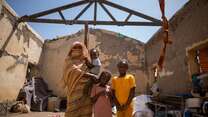
Some of the 5,000 students attending IRC-run schools at Jalozai camp in Pakistan
Providing stability amid upheaval
More than 5,200 children attend IRC-run schools at the Jalozai camp for those displaced by conflict. The schools provide a stable environment and a routine that helps the children recover from the traumatizing experiences many have faced. Teachers are trained to actively involve students in learning, increasing their self-awareness and confidence.
All IRC Slideshows >
All Refuge, Pakistan Slideshows >
The smiles are many and broad. It’s surprising when I consider what these children have been through. Some have been displaced since late 2008. Others fled their homes as recently as a few weeks ago. That’s when the latest round of fighting began between Pakistani troops and militants along Pakistan’s border with Afghanistan, sending more than a hundred thousand families fleeing from their homes.
Today, more than 5,000 children from those families are finding support and stability in schools run by the International Rescue Committee. There are now fifteen tent schools at Pakistan’s Jalozai camp, and with the need continuing to grow, another ten schools are planned.
In a handful of ways these are schools like the one you may have attended for second or third grade. There’s a chalkboard, a teacher, and a couple of dozen students. But that’s where the similarities end. These classrooms are long, white 30’ by 50’ canvas tents with window cutouts that flap in the late spring breeze. A couple of dozen students sit on the straw matted floor in groups of five or six, their sandals stacked neatly in a row alongside the entrance.
The teacher seems especially passionate; much more engaged than my Mrs. Paslewski was in second grade. In the class I sit in on, the teacher is instructing the kids on their English ABCs. They can’t get away with sitting back and watching the clock, daydreaming about recess. The teacher tosses a soft foam ball back and forth, requiring their attention. “B,” he calls out! “B for ball,” as he underarms the grapefruit-sized ball to a laughing girl. Every time the ball is caught, the kids shout in unison that indeed, “B IS for ball.” Then they turn to their penmanship book, and painstakingly trace out a “b” with a stubby pencil over printed scratch tracks. They examine each other’s work, and provide artistic feedback as required.
The teaching approach at Jalozai is a hybrid of an IRC education program called “Healing Classrooms,” and another from an IRC partner called “Right to Play.” Both are geared towards promoting psychosocial recovery and a basic education. I’m told the end result is teachers, students, and parents much more engaged in learning here than at more traditional schools. And these are kids who by and large, appear to crave learning. Many of the girls have never been to school before. They come from rural areas where custom requires they stay at home. Many others have had only a partial education, whether due to a damaged or destroyed school in their home village, or the fact that they were needed to watch the family livestock, or work in the fields. The IRC estimates that only one in five of the girls and only half of the boys were regularly attending school in their home villages.
Speak with parents, and they say there is one overwhelmingly positive aspect among all the negatives of living in a refugee camp like Jalozai. Here, their children have a chance to recover, adapt, and to learn. The bright eyes, laughter, and focus of the children indicate it’s working.
Get Involved
No comments yet.
Voices From...
Contributors


Comments
Post new comment