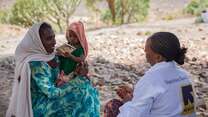
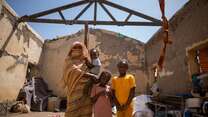
Zouzou holds a focus group to assess the needs of women in Sake Town on behalf of the gender-based violence emergency response team. Photo: Emily Meehan
A reporter with a Wall Street Journal Online column under her belt and media credits that include Slate and NPR, guest blogger Emily Meehan is relatively new to the work of international nonprofit organizations in conflict zones. She shares her impressions of her first weeks with the International Rescue Committee in the Democratic Republic of Congo, where an upsurge of violence has uprooted hundreds of thousands of people. (Read part 1 here.)
I recently accompanied two IRC colleagues who work on response and prevention of sexual violence. We visited the town of Sake, 40 minutes northwest of Goma, for an assessment of the security of women and girls. The scenery we passed – green mountains reminiscent of “Puff the Magic Dragon” – felt like a fantasy. But soldiers in untucked shirts lingering on the roadside with AK47s grounded the setting in the reality of war.

Photo: Emily Meehan
Sake, crouched at the base of lush hills, did not at first seem like part of a war zone. With no visible tents housing the displaced, the town of 5,000 has shops surrounding a central market, where hundreds of people lined up to receive free firewood being distributed by the IRC. This distribution to 20,000 families in North Kivu is designed to reduce the risk of rape that women and girls face when they search for kindling in isolated forests where armed groups operate. It was the IRC’s first, immediate step to help prevent sexual violence when the latest fighting broke out here.
On this day in Sake, my colleagues, Joviale and Zouzou, quickly found the chief in his office on the square. They explained in Kiswahili to the grey-haired man what they had come to do, to hold a discussion with women and girls about their security, their needs and problems. They talked with the chief about services available for women and girls who have been raped – medical and psychological support, and provisions to meet their basic needs. This is the second evaluation focused on women and girls that IRC has carried out in North Kivu. The first, in Kibati camp just outside of Goma, underscored the heightened threats women face even now, as the fighting has lulled and they find themselves in congested, highly militarized camps.
In Sake, my colleagues decided to hold a focus group. We approached the sheltered market stalls, where women with babies and young girls were sitting watching the firewood distribution. Joviale and Zouzou spoke to the group in Kiswahili, and soon we walked away into the quiet, walled yard of a nearby house, accompanied by about 20 women. After we shut the gate, several boys and one man climbed up the wall to peek into the proceedings, but Zouzou asked them to leave. The presence of men will inhibit women from discussing delicate topics like sexual violence; rape is a social stigma here, even leading some men to banish their wives or families to disown their daughters.
Joviale and Zouzou divided the women and began to speak to them in Kiswahili. We are here to find out what your needs are, they explained. We work to help women and girls. We provide counseling and medical referrals. We help teach communities that rape is not a woman’s fault, and that she needs the support of her family and community after such a trauma. The women looked skeptical. Then they began to speak about their problems.
I learned later, in French translation, what they were saying: We are displaced from our villages and our fields, they said. Our houses were bombed and armed men now occupy our land. We are sleeping here, sometimes without our own children, in the houses of extended family. We have nothing to use for hygiene during menstruation. We don’t have food. If we try to return to our fields to collect vegetables, we will be raped, or taxed. One woman said she had returned to her fields to collect a bushel of potatoes worth about $2. On her way back to Sake an armed man demanded the equivalent of $10 to pass; she didn’t have the money, and so was beaten. And yes, there have been rapes here, when women collect firewood in the forest or food from their fields.
Zouzou went to find the women’s group the chief told her about, and I waited in the town square, watching mothers with babies tied to their backs lift firewood onto their heads and walk off, balancing perfectly. Children gathered around me, little ones holding and shaking my hands. Most of them had distended bellies and some wore tattered white and navy blue school uniforms.
An old woman hung around with a long stick, shooing away children who annoyed her. She told us she lost her children when fleeing attacks, and that she now sleeps alone in a nearby orphanage.
Back at the office a bumpy drive later, our emergency coordinator of programs that respond to sexual violence, Sarah Spencer, debriefed her two staff with pluck and efficiency. I noticed that Joviale was almost done filling out a report with various assessment categories – displacement, needs, security, psychological health, violence.
IRC is working with partners in Goma to mobilize better services for women in Sake. They need medical referral and care, and psychological support.
In the meantime, the IRC team pushes forward its response for women and girls in camps outside Goma. They’re working with the IRC reproductive health team to train state health workers on appropriate treatment of rape. They’re working with partners to set up referral systems so women can access services. And they’re going to provide 9,000 women and girls with sanitary materials and flashlights to improve their hygiene and safety conditions.
All that, after just a few days of assessment like this one. As they call it here, an
evaluation rapide.