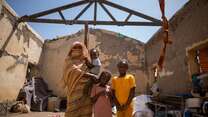
Since 1933, the IRC has provided hope and humanitarian aid to refugees and other victims of oppression and violent conflict around the world.
The IRC on Twitter
VOICES FROM THE FIELDTHE IRC BLOG
Trying to save the world, one Congressman at a time
October 24, 2008
By tim.lash
The job of our team is to understand the needs of people who have been uprooted by war, civil conflict or ethnic persecution and then lobby the U.S. government to come to their aid. We work to garner support for IRC programs and for the issues we care about: health care, child survival, stopping violence against women, post-conflict development, and good governance. And if that isn’t hard enough, we work with government officials who are notorious for having a short attention span for anything that’s not easily translatable into a five-second sound bite.
The most important lesson I learned while working in Washington, much to my surprise, is that the majority of Congress people are extremely accessible and ridiculously ordinary. I do not say this out of disrespect or to shock anyone, but only to say that our government is more democratic and open than I ever thought it could be. Anyone can walk into a government office, in their home district or in Washington, and set up a meeting with their senator, representative or a member of their staff.
This fact completely changed my idea of government being detached from everyday life. This is why the IRC has advocates on behalf of our humanitarian efforts in saving those who need it most. Some members of Congress care about nuclear warheads, others care about energy policy, healthcare, farmers, pets, or what have you. The IRC, in particular, seeks out Congress people and state officials that care about refugees and the other victims of war who are left displaced, vulnerable and in need of help. That means whoever is working in our office is doing the best to set up every meeting, attend every forum, basically be everywhere at once where people gather to debate U.S. policy toward global hotspots, in order to prove to politicians that we are doing the best job in the whole world at protecting refugees and seeing that the world's most vulnerable have a place to turn. The IRC and many other NGOs and government supported organizations all have an interest in influencing the debate on humanitarian issues.
What makes the IRC different? Call me crazy, but I think the IRC has some of the most educated, driven, experienced and well rounded people in Washington, DC. We are no nonsense. We get down to the nitty-gritty programming and execution. We have to communicate back and forth on the ground to countless countries where our personnel are hard at work, often risking their lives for the lives of others. Our experienced field workers are the cornerstone of our organization upon which we ground our advocacy. Before we speak, we want our work to precede us.
Even with all this on their plates, my colleagues somehow manage to stay sane. They are working, quite simply to save the world. And they know that as long as they keep pushing, progress can be made little by little. Ever so slowly, that battle for awareness or funds or equipment that initially seemed as steep as Mt. Everest becomes more like a rolling hill.
There are billions of ways we can make change just by speaking our minds about issues to government decision makers. If it’s not starting at a monetary donation, it’s creating ‘awareness’ — and from there, hopefully, information and involvement will spread like wildfire. It’s really that simple. Go figure.
No comments yet.
Voices From...
Contributors


Comments
Post new comment