International Rescue Committee (IRC)

VOICES FROM THE FIELDTHE IRC BLOG

Return to Azakhel Camp, a year after the floods

Some of the handful of Afghan refugees who still live in Pakistan's Azakhel Camp, a year after they survived record floods in Pakistan.

Photo:Ned Colt/IRC

Return to Azakhel

  • A boy stands in front of stagnant water and debris in a photo from 2010
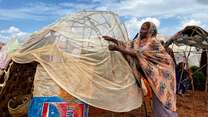
  • Two women stand outside a tent
  • Flood victim Mir Salam in a picture from a year ago, sits next to his belongings
  • An aerial view of Azakhel showing trees and a few cows, but no houses.
  • Elders at the Camp look over Peter Biro's photos from a year ago.
  • Mir Salam wearing a broad smile
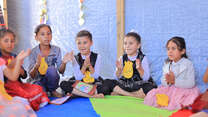
  • Two young girls eating at Azakhel Camp
  • A young boy smiles at the camera
  • Akhtar Muhammad speaks to the IRC about life in Azakhil Camp
  • A mason lays bricks for a future religious school for girls

A year ago the Azakhel Refugee Camp in western Pakistan was home to thousands of Afghan refugees. Many had lived there their entire lives and had build sturdy mud brick homes. But in August of 2010, the worst flash floods in living memory roared through the camp, washing the homes away. The IRC's Peter Biro documented the conditions with his camera immediately after the waters began to subside. Peter's colleague Ned Colt went back to Azakhel in the summer of 2011 to see what had changed.


All IRC Slideshows >
All Pakistan Slideshows >

Return to Azakhel

  • A boy stands in front of stagnant water and debris in a photo from 2010
  • Two women stand outside a tent
  • Flood victim Mir Salam in a picture from a year ago, sits next to his belongings
  • An aerial view of Azakhel showing trees and a few cows, but no houses.
  • Elders at the Camp look over Peter Biro's photos from a year ago.
  • Mir Salam wearing a broad smile
  • Two young girls eating at Azakhel Camp
  • A young boy smiles at the camera
  • Akhtar Muhammad speaks to the IRC about life in Azakhil Camp
  • A mason lays bricks for a future religious school for girls

A year ago the Azakhel Refugee Camp in western Pakistan was home to thousands of Afghan refugees. Many had lived there their entire lives and had build sturdy mud brick homes. But in August of 2010, the worst flash floods in living memory roared through the camp, washing the homes away. The IRC's Peter Biro documented the conditions with his camera immediately after the waters began to subside. Peter's colleague Ned Colt went back to Azakhel in the summer of 2011 to see what had changed.


All IRC Slideshows >
All Pakistan Slideshows >

They are distressing photos, but the community elders are almost giddy as they study them.  “Yes, that’s him!” one calls out in Pashto, jabbing a finger at a bearded man in one photo. “That one there? She gave up and moved to the city,” another shouts.  They are poring over a photographic record of last summer’s devastating floods, shot by my International Rescue Committee (IRC) colleague Peter Biro.

I’m at the windblown remains of the Azakhel refugee camp, one of Pakistan’s oldest centers for Afghan refugees.  It’s almost two miles long and close to three decades old, and as thousands learned last August, it’s located on a flood plain.  When the annual monsoon rains developed into lethal floods, almost the entire camp of a thousand mud-brick homes was inundated.

I’ve come to Azakhel ten months after Peter. Ten months after the IRC and other humanitarian organizations launched a massive relief effort across the three hardest hit regions of Pakistan. I’ve come to Azakhel to meet with those who’ve stayed here, and to learn how they’ve fared.

The elders beckon me to follow them across railroad tracks into what was the heart of the camp.  It’s the end of the dry season, so the land is parched. In every direction I see the remains of houses alongside well-trod paths. Mature eucalyptus trees provide some shade, but the heat is unrelenting. 

Here and there, boys struggle with wheelbarrows almost as big as themselves, hauling bricks they have salvaged from the mud. They stack them neatly where homes used to stand. While no one has been allowed to rebuild due to the flood threat, I’m told the piles continue to rise in hope that the Pakistan government will rescind the ban. But at least two thirds of the residents have moved away; those remaining live in ragged tents.

My guide indicates a burly man headed our way. Then he points to one of Peter’s photos from last year.  In the picture, the same man is sitting on a pile of debris, an island in the stagnant water. He is bearded like most Pashtuns; he’s obviously been searching for his belongings, because his hands are caked with dried and cracking grey mud. In the photo he looks angry and bitter, different from the smiling man approaching us. 

His name is Mir Salam; he’s 45 and came to Azakhel as a boy of 11. A year ago, he cared for his family of ten with the proceeds from his three auto-parts shops.  Post-flood, he’s down to one small garage where he separates metal scrap for recycling.

“There is nothing remaining here,” he says. “Everything is gone. My shops and my business.” But then he breaks into a broad grin. “You know? I can still smile, because I am alive, as is my family, so we are alright.” 

For now, the remaining residents of Azakhel have no idea what the future holds. Because the camp is on a flood plain, the government wants them to leave, fearing another deluge this summer. It is increasingly tough for those who remain to get by.

In the 80’s and 90’s, the IRC and other humanitarian organizations were active in the camp. The IRC helped to build and operate schools here, but they have been washed away. The IRC also helped dig wells and provide sewer services. Today, residents still use these hand pumps, but flooding has contaminated the groundwater. In the entire camp, I see only one construction project, a mason erecting a small wall. “It’s for a new madrasa,” a blind cleric tells me. “Here we will have Koranic studies for girls; we have already built a religious school for the boys.”

It’s something, but not enough. As 24-year-old truck driver Akhtar Muhammad tells me, “We can’t understand what is happening here. We are just passing time, hoping we can rebuild our homes.” 
 

No comments yet.

Comments

Post new comment

The content of this field is kept private and will not be shown publicly.
Type the characters you see in this picture. (verify using audio)
Type the characters you see in the picture above; if you can't read them, submit the form and a new image will be generated. Not case sensitive.

ABOUT THIS BLOG        COMMENT GUIDELINES        DONATE        ARCHIVE