Announcement
The IRC is saddened to learn about the passing of Dr. Jim Strickler - a friend, mentor, and one of the most dedicated leaders in the IRC’s history. He was 99. For more than four decades, Jim shaped the IRC not only through his vision and governance, but through the example he set as a physician who chose, again and again, to show up in person for the people the organization serves.
"His intelligence, openness, professionalism, compassion and principles were evident in every conversation. He inspired generations of staff at IRC and we were so proud of our connection to him." – David Miliband
A career devoted to service
Jim's relationship with the IRC began in the field, not the boardroom. After retiring as Dean of Dartmouth Medical School in 1981, Jim and his wife, Pegge, signed on as IRC volunteers and went to Thailand for a six-month assignment — Jim as a hands-on physician in the pediatric ward of Khao-I-Dang, Thailand's largest refugee camp for Cambodians, and Pegge teaching English to refugee children. The conditions were harsh: an open-sided hospital with a bamboo roof and concrete floor, no air conditioning, and a high mortality rate among patients. "Thailand was a watershed experience in our lives," Jim later said. It was there, treating the most vulnerable patients in some of the most difficult circumstances imaginable, that Jim's lifelong commitment to the IRC's mission took root.
That commitment never wavered. Over the following decades, Jim undertook at least 25 overseas trips with the IRC, working across Asia, Africa, and the Balkans. His 25th trip, taken at the end of the war in the Balkans, included a moment that captured how deeply Jim's colleagues had come to admire him: as he flew between Albania and Macedonia to visit Kosovar refugees, then-IRC President Reynold Levy marked the milestone with cake and candles on the plane — a small but fitting tribute to a man who had quietly made that kind of commitment look routine. Wherever there was a crisis, Jim was willing to go — not only as an IRC leader, but as a physician with sleeves rolled up.
The driving force behind IRC's health unit
Jim's impact extended well beyond his own fieldwork — and it was here that his influence was, perhaps, most lasting. When Jim joined the IRC Board in 1982, refugee health programs across the organization were largely run by highly motivated volunteers, but lacked a structure led by health professionals. Jim set out to change that. As chair of the IRC's executive committee from 1990 to 1999, he was the driving force behind the creation of the IRC's health unit — building the case for, and helping establish, a dedicated unit to provide medical care to refugees and displaced people, and personally helping recruit the IRC's first full-time staff physician.
That health unit became, in Jim's own words, one of the organization's most important activities — and it remains so today. Few single contributions have done more to shape how the IRC delivers care to the people it serves, and the structure Jim helped build decades ago continues to operate at the heart of the organization's mission.
A steward of strong governance
Jim joined the IRC Board of Directors in 1982, beginning a tenure of board service that would span more than four decades. From 1999 to 2004, he served as Co-Chair of the Board of Directors alongside his close friend and partner in leadership, Winston Lord, and he has served on the Board of Advisors since 2004.
Together, Jim and Winston were deeply committed to strong, accountable board governance. They led an overhaul of the Board's structure during their tenure as co-chairs — much of which remains intact today. In 2004 the two of them led the effort to shrink what had become an unwieldy Board, building a strong consensus around the need to slim it down. Notably, through their joint diplomatic efforts, not one of the members assigned to the newly formed Overseers (later Advisors) group protested the change — a testament to the trust and respect Jim and Winston had built across the organization. Their work ensured that the IRC's governance would be as resilient and forward-thinking as the humanitarian mission it was designed to support. As Sarah O'Hagan reflects:
"What they demonstrated in every interaction was their great respect for and enjoyment of one another — their co-chair tenure was a master class in effective partnership. They never missed a chance to laud one another, to toss a little verbal bouquet in the other's direction, to reference a need to consult the other before any decision. It was a stylistic tic but more important it laid down the track for how IRC co-chairs would work together. Alan and Jonathan, and Tom and I, stepped into the path they grooved — and were the beneficiaries of the heavy lifting they had done to modernize and streamline IRC's governance, creating and sustaining two functioning governing bodies." – Sarah O'Hagan
A legacy that endures
Jim Strickler's legacy lives on in the health systems he helped build, the governance structures he helped design, and in the countless refugees and displaced people who received care because of the programs he fought to build. He embodied a rare combination: the rigor and compassion of a physician, and the strategic clarity of an institutional leader.
He was also known, as Winston's words below capture, for a sharp sense of humor that put everyone around him at ease — and for a genuine, lifelong commitment to inclusivity. Whether advocating for more women around the boardroom table or championing greater representation of women in medical school classrooms, Jim believed that the institutions he cared about were only as strong as the range of voices shaping them.
"Jim Strickler is one of the giants in IRC's long history. He was also one of the most decent human beings I have ever known… A distinguished physician, he was the leader in the creation and development of the far flung health program, one of the IRC's global signatures. With John Whitehead's backing, he effectively ran the IRC for several years until he and I were selected to be Co-Chairs of the Board from 1999 to 2004. Divided leadership can be difficult, but during a challenging period we worked together without a single instance of contention, subsuming egos and relying on our respective expertise.
Jim used to say that there are two kinds of directors: Those who are gone but not forgotten, and those who are forgotten but not gone. He was never in the second realm. Proudly but sadly, he now occupies the first. Like the IRC, I will never forget our close bonds, one of the true blessings in my "golden years." Until the end we kept in close touch, solving world problems on the phone and in an unpretentious diner on Madison Avenue.
Above all, Jim was a family man, invoking his beloved wife, Pegge, and two generations of his family in every one of our encounters. They will miss him. The IRC will honor him. I will do both and cherish our friendship." – Winston Lord
We extend our deepest condolences to Jim's family, friends, and the many colleagues across the IRC who had the privilege of working alongside him. His decades of service leave an indelible mark on this organization and on the lives of those it serves.
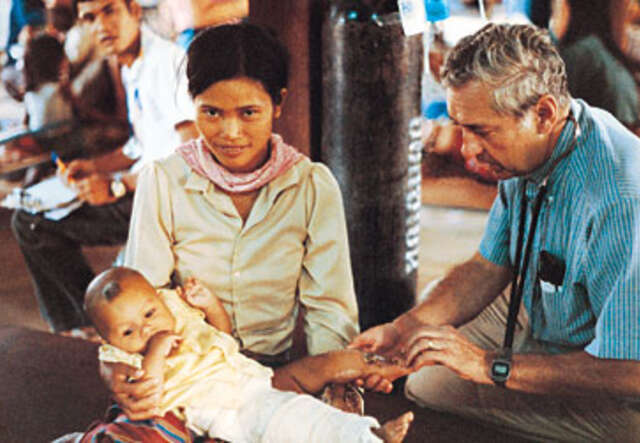
Thousands of refugees around the world—including this Khmer mother and her child—have benefited from Jim Strickler's care.
Photo: Photo courtesy of Dartmouth Medicine