Announcement
Growing up, Albert knew two seasons: the dry season was better for fishing along the Logone River, and the rainy season was spent helping his parents grow crops—soghum, sugar cane, cotton, corn and roselle—at his family’s farm in Chad. He remembers working alongside his grandparents at the age of five—parting earth to plant seeds, nurturing the plots, and using traditional techniques at harvest. As he grew older, he would help his family farm between breaks in the school year.
“I was told that if I liked to farm, I must follow the timeline of the season and the maturity of the crops,” Albert reflected. His early lessons in farming followed him, even as he faced difficulties and upheaval.

Albert shared his story at an event during Sundance 2026, discussing his path to the United States and joining the New Roots farming program at the IRC in Utah.
Photo: Katie Lasak Photography/Food Tank
In 1979, the civil war in Chad broke out; Albert was in high school. “The southern part [of Chad] where I grew up is the one that paid a heavy price,” he described, noting that he was separated from his family as he sought asylum in Burkina Faso. Albert arrived to safety in 1986, but his family did not join him for another ten years, including his wife and two daughters. In 1999, Albert and his family resettled as refugees to Utah.
“I came to Utah from Africa in 1999 and I was involved in refugee communities, assisting refugee families under Catholic Community Services and Asian Association of Utah organizations as a volunteer. Helping refugee families with transportation to go shopping or to go to their appointments. Also, I help translate some documents in English / French language,” Albert said. In just a few years, Albert and his family moved into a house with a yard where he began tending a small garden plot: corn, tomatoes, and peppers.
In 2010, the International Rescue Committee (IRC) in Utah launched its New Roots program. Albert was one of the first to join.
“With New Roots, I grew different variety of crops each year in the US such as Amaranth, Arugula, Potato, Roselle, and so forth. I also farmed some similar crops as I did in Chad,” Albert noted, though mentioned that other familiar crops from Chad—like sorghum and millet—could not grow in Utah’s more arid climate. At first, Albert grew fresh food for his family & friends, but soon he started to grow enough to sell at local restaurants and markets: “The money we made was not enough to cover our expenses, but it was significant.”
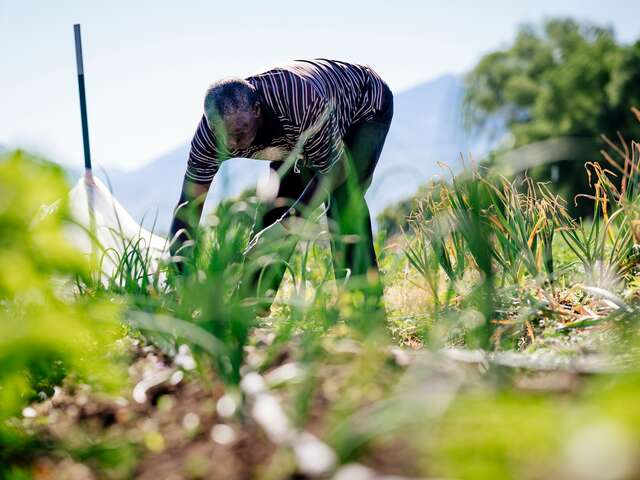
Albert has always loved farming: "Working at the farm makes me happy because it is a physical activity. You use all your body: arms, legs, back, even your brain. Digging, planting, weeding and harvesting are good for my mental and physical health.”
Photo: James Roh
Today, Albert is one of 55 farmers participating in the New Roots program, offering fresh, local-grown produce to communities across Salt Lake County and beyond. In 2025, Albert and his fellow New Roots producers grew over 625,000 pounds of produce offered to wholesalers and through local markets, including providing fresh food assistance to community members facing food insecurity.
When asked why he enjoys farming with the New Roots program, Albert confirmed: “Working at the farm makes me happy because it is a physical activity. You use all your body: arms, legs, back, even your brain. Digging, planting, weeding and harvesting are good for my mental and physical health.” He also added that the community of farmers is an important reason to stay with the program: “I came here to Utah as a Refugee, and I met other Refugee families with different backgrounds and different cultures farming together.”
The new growing season is here & New Roots farmers are ready to bring fresh produce to the community! Right now, you can join a farmer’s Community Supported Agriculture offering—a weekly vegetable pickup ready for the dinner table. In June, the New Roots Farmers Markets will start on Wednesdays and Saturdays. Learn more about these opportunities & more at NewRootsSLC.org »