Announcement
What is SNAP?
The Supplemental Nutrition Assistance Program (SNAP) is a 100% federally funded program—states do not pay for benefits. SNAP is a critical lifeline for:
- Children
- Working families
- Seniors
- Disabled adults
Food banks help, but for every meal a pantry provides, SNAP offers nine.
In Phoenix, AZ, 16% of residents live in poverty (about 270,000 people).
Why Does SNAP Matter?
- Health Benefits: Improves health outcomes, reduces healthcare costs, supports children, older adults, and people with disabilities.
- Economic Impact: Every $1 in SNAP generates up to $1.80 in economic activity during downturns—helping retailers, farmers, and local businesses.
- Education & Workforce: Access to food supports kids in school and adults in job training, critical in our immigrant-heavy communities.
- Long-Term Benefits: Early access to SNAP improves education and economic outcomes, breaking cycles of poverty.
Major Change in 2025
The One Big Beautiful Bill Act (OBBBA), signed July 4, 2025, dramatically changed SNAP eligibility for non-citizens.
What Changed?
Removed Eligibility for:
- Refugees
- Asylees
- Victims of trafficking
- VAWA self-petitioners (domestic violence survivors)
- Humanitarian parolees (including Afghan/Ukraine parole)
- Certain special immigrant visa holders
(Previously, these groups were exempt from the five-year wait and could access SNAP immediately.)
Who Remains Eligible?
- U.S. citizens and nationals
- Lawful Permanent Residents (LPRs) — usually after 5 years, unless exempt
- Cuban/Haitian entrants
- Citizens of Compact of Free Association nations (Micronesia, Palau, Marshall Islands)
Impact Overall and in Phoenix
- Refugees and asylees who have not adjusted to LPR status are now categorically ineligible for SNAP.
- Changes took effect immediately and are enforced at new applications and recertifications.
- States had a 120-day grace period for implementation (ended Nov 1, 2025).
In Phoenix:
- ~400,000 Phoenix residents rely on SNAP, many from refugee families. [azcentral.com]
- Local food banks report empty shelves and new families expressing need. [azcentral.com],
- Mayor Kate Gallego called it an “all-hands-on-deck situation,” urging donations and volunteers.
Snapshot of Arizona’s Refugee Population
Arizona has long been a major resettlement state, welcoming thousands of refugees from Afghanistan, Somalia, Syria, and the Democratic Republic of Congo.
Before Cuts: Refugees relied heavily on SNAP for food security while integrating and finding work.
Now: Families are losing benefits, forcing choices between rent and food. Aid groups warn this will hinder ESL classes, job training, and integration efforts.
What Is Lawful Permanent Resident (LPR) Status?
LPR = Green Card Holder
- Eligible for SNAP after 5 years, unless exempt:
- Children
- Disabled individuals
- Military-connected
- Certain American Indians and Amerasians
Important: Eligibility changes apply to both adults and children.
- Refugee/asylee children no longer qualify unless they are U.S.-born or have LPR status.
- Loss of SNAP also means loss of direct certification for free school meals.
Other Major Changes
USCIS issued a memo (Nov 21, 2025) requiring re-interviews for refugees admitted between Jan 20, 2021, and Feb 20, 2025, to reassess eligibility and inadmissibility.
- Adjustment-of-status applications for these individuals are paused.
- Refugee status cannot be revoked overnight; due process is required.
- Work authorization remains valid during review.
Summary Table: Pre- vs. Post-OBBB SNAP Eligibility
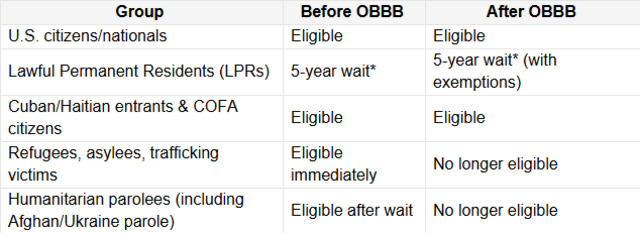
*Exemptions: children, disabled, military connected.
For those facing food insecurity:
- Call 2-1-1 to receive information about food pantries, meal sites and other community resources to support your situation. Calls are supported in English and Spanish as well as a variety of other languages through interpretation.
- Visit 211Arizona.org to identify emergency food resources or to contact a representative via email or live chat.
Find a resource near you:
For those who can lend a helping hand:
Donate to our Soft-Landing Fund, or donate grocery and/or Visa gift cards to the IRC
- We cannot currently accept bulk food donations, but we are working to collect grocery gift cards to fill in gaps for families in need. Gift cards to stores like Winco, Fry’s, and Walmart ensure families can decide what to stock in their pantry or fridge.
- You can drop off gift cards, mail them in, or purchase directly from our Wish List.
Email us at Phoenix@rescue.org for more information.
Get involved:
- Support local food pantries and distribution sites: While the IRC has limited ability to accept bulk food donations, consider a donation to the St. Mary’s Food Bank or a local pantry. Find a pantry near you »
- Join the fight against hunger in Arizona: https://azfoodbanks.org/join-fight/
- Stay educated on Arizona’s hunger crisis: https://www.feedingamerica.org/hunger-in-america/arizona
- Join Phoenix food drives: City-run drive locations include public centers like Burton Barr Library and Cesar Chavez Community Center
Contact your elected officials:
- We are asking you to contact your Congressional representatives to advocate for the full funding of federal nutrition programs like SNAP, WIC, and TEFAP.
If this is your first time contacting your representative, don’t worry – it’s pretty easy!
- Find Your House Representative
- Send an Email: Both Feeding America and the Food Research and Action Center have easy ways to contact your representatives with one click!
- Make a Call: visit FRAC’s page for a sample script.
- Need to find your rep’s number? Find My Senator
Contact us to learn more about supporting local refugee families by reaching out at Phoenix@rescue.org. To deepen your support, consider making a one-time contribution or starting a monthly donation in support of our work in Phoenix, AZ at https://help.rescue.org/donate/us-phoenix-az