Refugees are people who have fled their home country due to war, persecution, or political upheaval. Some eventually return when it’s safe to do so; others stay in temporary refugee settlements or integrate into nearby countries offering asylum, while a tiny fraction resettle in a third country, such as the United States. Thirty-two percent of the global refugee population are hosted in just five countries: Islamic Republic of Iran, Türkiye, Colombia, Germany and Uganda.
Recent U.S. policy changes have limited refugee resettlement. The refugee admissions program remains largely suspended, and the 2025 travel bans continue to block people from several countries, including those who have fled danger and persecution.
Refugees already living in the U.S. face hardships too. Those who haven’t yet received permanent residence (a green card) are being re-interviewed even though they went through extensive vetting before arriving in the U.S., putting families who have already endured so much at risk of further trauma. And under H.R.1, the “One Big Beautiful Bill Act,” many have lost federal eligibility for food assistance and health coverage, supports that helped refugees build stable lives in their new communities.
There are still simple ways you can help refugees in the U.S. and support the IRC’s work to help people survive, recover and rebuild.
The U.S. Refugee Admissions Program (USRAP) is a safe, orderly and cost-effective pathway for people fleeing conflict and crises, supported by both Republicans and Democrats since its creation under the 1980 Refugee Act.
It has offered over 3 million security-vetted refugees a chance to start anew in America. Refugees significantly contribute to their communities, driving economic growth and reinforcing America's global reputation as a leader in humanitarian efforts.
USRAP operates independently from asylum and border systems, with its own funding and management. Despite its global significance and humanitarian focus, support for refugees receives only a tiny fraction of overall government resources.
On January 20th, 2025, the Trump administration issued an executive order that suspended refugee resettlement, and on February 7, 2025, it provided an exception, permitting the admission of Afrikaners from South Africa.
Suspending the USRAP has harmed those fleeing persecution and blocked families from reunification. Many refugee families are being forced to live apart indefinitely, unable to rebuild their lives together.
IRC clients have shared their heartbreaking stories of separation. Three siblings in Washington state, resettled in 2023 after fleeing the war in Syria, are separated from their mother, whose travel was canceled in February 2025 after nearly a decade of waiting. A mother in California is separated from her adult son, an ethnic Armenian Christian from Iran, whose travel was canceled just weeks after his fiancée was resettled via the Lautenberg program.
Family reunification is not just a humanitarian priority; it is essential for emotional stability, healing, and building strong, supportive communities. Prolonged separation also damages America’s global reputation, strains the refugee protection systems in other parts of the world, and deprives communities of economic and cultural benefits.
The travel bans, first issued in June 2025 and expanded in December 2025, have deepened these separations by blocking or restricting people from 39 countries, including those who have fled danger and persecution.
A refugee couple in Kansas who fled decades of conflict in Somalia, for example, are blocked from reuniting with their three adult children. After years of waiting in Uganda as refugees, the adult children were told by the U.S. Embassy to come to Kenya for their visas, only to receive a letter saying the travel ban barred them from entering the U.S. The family has not been together in over 20 years.
Refugee resettlement brings economic benefits to host countries. Refugees expand a country’s workforce, generate economic activity as consumers, and create jobs as entrepreneurs. Over time, rising earnings and tax contributions can also strengthen public finances and local communities.
A 2025 study found that immigration policies enacted by the Trump administration would reduce the country’s projected number of workers by 6.8 million in 2028, culminating in a $1.9 trillion reduction in expected GDP while substantially increasing the federal debt. Another study by the Department of Health and Human Services found a nearly $124 billion positive fiscal impact of refugees and asylees on the U.S. economy between 1990 and 2022.
The IRC’s Economic Empowerment Programs have placed nearly 3,000 clients in high-demand sectors such as food manufacturing, health care, and hospitality, strengthening both individual livelihoods and local economies.
The USRAP is managed by the U.S. government, which works with the UN Refugee Agency (UNHCR) and designated humanitarian agencies to identify, screen and vet prioritized populations for resettlement.
The U.S. accepts a limited number of refugees each year. The president, in consultation with Congress, decides the target level of refugee admissions for a given year and issues this decision via a Presidential Determination.
The Trump administration set the lowest-ever annual refugee cap at 7,500 for fiscal year 2026, before raising the cap to 17,500 resettlement slots that were to be “primarily” allocated to Afrikaners. The refugee cap for fiscal year 2027 remains at 17,500, primarily for Afrikaners, with no slots allocated to refugees who fled danger anywhere else in the world.
These numbers indicate a stark decline from the average annual admissions cap of 95,000 under both Republican and Democratic administrations since the program was founded.
Applicants for refugee admission to the U.S. must satisfy the following criteria:
- Meet the definition of a "refugee" as determined under U.S. law
- Be among those of special humanitarian concern to the U.S., as designated by the President through the annual refugee admissions ceiling
- Not be firmly resettled in another country
- Pass medical, security vetting, and background checks
- Be otherwise admissible to the U.S. under immigration law
Even if an individual meets all the criteria, the USRAP does not confer any right or entitlement to be admitted to the U.S.
Refugees admitted through the USRAP undergo more intensive vetting than any other group seeking entry. Most are identified and referred for resettlement by UNHCR, a U.S. embassy or an approved humanitarian organization. The U.S. government then selects each refugee individually, with trained Department of Homeland Security officers determining whether they meet the legal definition of a refugee.
All refugees must pass security screenings led by U.S. government authorities, including the FBI, the Department of Homeland Security, the Department of Defense and other security agencies. These screenings include biographic and biometric checks, medical tests, forensic document testing and in-person interviews. The process can take years and is followed by further security checks after refugees arrive in the U.S.
Despite this, the administration is re-reviewing refugees’ status, creating further uncertainty for families who have worked so hard to rebuild their lives.
Resettlement Support Centers (RSC), run by humanitarian organizations through agreements with the Department of State, help refugees and their families prepare their cases for processing and security vetting, including by compiling personal data for interviews with officials from the Department of Homeland Security.
Once refugees are cleared for resettlement, the U.S. government works with the IRC and other national resettlement providers to help them restart their lives in America.
Refugees are usually placed in a city where they have relatives or friends, or where there is an established community that shares their language or culture. Other considerations include the cost of living and access to medical services. However, as legal U.S. residents, refugees can ultimately live in any state they choose.
These are some of the steps included in the resettlement process:
Preparation for travel
Before refugees leave the countries where they temporarily reside, they sign promissory notes agreeing to reimburse the U.S. government for travel costs. They also attend a class to learn about what to expect when they arrive in their new country, with briefings on American culture, U.S. laws, health care access and other critical information. Officials also conduct a final screening and additional security checks before departure.
Arrival in the U.S.
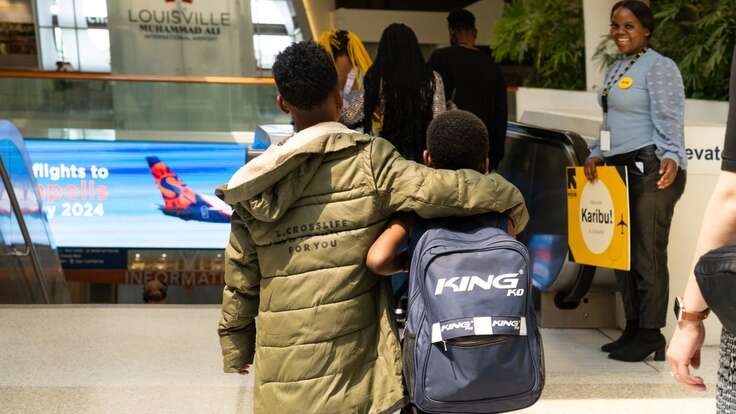
Refugees are greeted and welcomed at the airport by caseworkers from resettlement agencies like the IRC to ensure their transition is as comfortable as possible. Agencies are responsible for finding a suitable, affordable home for refugee families, something many of these refugees have gone without for years. Families also receive basic furnishings, food and other immediate assistance for a limited period of time.
Getting on their feet
For the first 90 days, resettlement providers work with state and local governments and community organizations to help newly arrived refugees settle into their communities.
- Refugees are encouraged to find work quickly—and most do. Providers reach out to local employers, some run by former refugees or other immigrants, to find job opportunities for them. Refugees can also receive support in putting together their résumé and preparing for job interviews.
- Learning English is an essential step to becoming self-sufficient. Providers help assist refugees to enroll in English courses at their local offices or help families find classes nearby.
- Parents are informed about schooling options and caseworkers help to enroll children in school. Providers help ensure each child has a backpack, notebooks and other supplies for their first day.
- Refugees are introduced to their local health care system. Although they have had thorough check-ups before entering the U.S., they receive additional examinations by medical professionals in their new communities.
- Newly arrived refugees have endured years of trauma and hardship, and that emotional burden does not lift once they’re in the U.S. Service providers and local communities work together to help survivors of violence and human trafficking receive the support and care they need in order to recover.
Once they acclimate to their new environment, refugees thrive and contribute to their communities, starting careers, purchasing homes and creating new businesses
The IRC resettles refugees through a network of 28 offices across 17 states, a public-private partnership between the U.S. government and nonprofit organizations.
We work directly with new arrivals and welcoming communities to implement resettlement and integration services, providing temporary financial assistance, employment services, workforce development, interpretation services, cultural orientation, school registration, and other programs.
Each resettlement office serves as a free, one-stop center for refugees’ needs during their pivotal first months in the U.S. Through a network of staff members and volunteers, the IRC helps refugees learn about life and customs in America, secure jobs, and learn English. We provide most of the basic support they need to restart their lives here and help them overcome cultural barriers so that their adjustment is as easy as possible.
Through community gardening, nutrition education and small-business farming, the IRC's New Roots program also gives hundreds of refugee farmers the tools and training they need to grow healthy and affordable food and become self-sufficient.
The IRC works in more than 40 countries and in 28 U.S. cities to help people affected by humanitarian crises survive, recover and rebuild their lives. Learn more about our U.S. offices:
- Abilene, TX
- Atlanta, GA
- Baltimore, MD
- Boise, ID
- Charlottesville, VA
- Dallas, TX
- Denver, CO
- Elizabeth, NJ
- Iowa City, IA
- Kansas City, KS
- Los Angeles, CA
- Louisville, KY
- Miami, FL
- Missoula, MT
- New York, NY
- Oakland, CA
- Phoenix, AZ
- Richmond, VA
- Sacramento, CA
- Salt Lake City, UT
- San Diego, CA
- San Jose, CA
- Seattle, WA (SeaTac, WA)
- Silver Spring, MD
- Spokane, WA
- Tucson, AZ
- Turlock, CA
- Wichita, KS
The IRC urges the Trump administration to reverse course, fully restore the refugee resettlement program and rescind the travel bans. We also ask the administration to reconsider unnecessary re-vetting efforts that are retraumatizing refugee communities across the U.S. Protecting due process, honoring humanitarian commitments, and safeguarding the stability of close‑knit American communities are essential to who we are as a nation.
The IRC also encourages members of Congress to restore access to SNAP, CHIP, Medicaid and other critical services that support refugees in their first months in the U.S.
Everyone can help refugees by welcoming them as new and valuable members of American society.
You can volunteer at a local resettlement provider; become an English tutor, or a mentor to a family; donate money, furniture and household items; educate other people about refugees; and employ or encourage local businesses to hire refugees.
Ways to help right now:
- Help the IRC support refugee families in crisis with a donation: Donate now
- Look for IRC volunteer opportunities assisting refugees in the U.S.
- Rent to refugees.